# Tool Cart
-
 Quick View
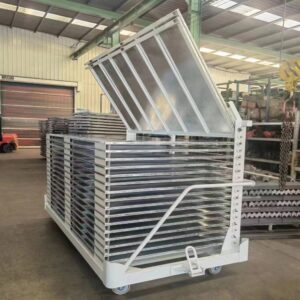
Industrial Tool Carts for Flexible Material Handling and Organized Workspaces
Tool Carts are mobile industrial storage and handling equipment designed to organize tools, components, materials, and work-in-process items while allowing them to be moved easily between different work areas.
Unlike stationary shelving, a tool cart combines storage and mobility in one unit. Operators can keep tools or materials organized in dedicated compartments and move the complete cart directly to the workstation, production line, warehouse, or maintenance area.
JULI® manufactures industrial tool carts and custom material handling carts for manufacturing, maintenance, automotive, tire production, warehouses, logistics, and other industrial applications.
Depending on the application, carts can be equipped with multiple shelves or compartments, industrial casters with brakes, guard rails, labeling holders, forklift pockets, foldable structures, and other customized features.
Explore our Tool Cart collection to find a mobile storage and handling solution designed around your tools, materials, and workflow.
What Is a Tool Cart?
A Tool Cart is a mobile storage unit designed to organize and transport tools, materials, components, or equipment within a workplace.
A typical industrial tool cart consists of a steel frame, storage shelves or compartments, and heavy-duty casters that allow the cart to move between different locations.
Depending on the application, the cart can be configured with:
- Multiple storage levels
- Compartments
- Dividers
- Guard rails
- Handles
- Industrial casters
- Braking casters
- Forklift pockets
- Label holders
- Specialized supports
The basic operating cycle is simple:
- Load
- Organize
- Move
- Use
- Return
- Reuse
This makes a Tool Cart more than a mobile shelf.It becomes part of the material handling process.
What Are Tool Carts Used For?
The main purpose of a Tool Cart is to bring tools, components, and materials closer to where they are needed while keeping them organized and easy to move.
Instead of storing tools in one fixed location, operators can move a complete tool cart to the required workstation.
This is useful for maintenance, assembly, production, inspection, and repair operations.
Different compartments, trays, shelves, and dividers can be used to separate tools, hardware, spare parts, production materials, or work-in-process products.
Tool carts can be configured for use beside production lines, allowing required materials to remain close to the operators.
Instead of carrying individual items back and forth between storage and production areas, multiple items can be transported together on one cart.
Maintenance teams can organize tools and replacement components on dedicated carts and move them directly to machinery or service areas.
A customized cart can be designed around specific products or production components rather than using a general-purpose shelf.
Why Use Tool Carts?
Maintenance technicians, assembly workers, and production teams may need different tools or components at different locations.
A mobile cart allows the storage unit to move with the operation.
Production layouts can change, particularly in manufacturing facilities with changing product lines or production schedules.
Mobile storage equipment can adapt more easily than permanently installed storage.
Loose tools and components can quickly create clutter around production areas.
Dedicated compartments and shelves help separate materials and make commonly used items easier to identify.
Keeping materials near the workstation can reduce repeated trips to a warehouse or central storage location.
Industrial carts can be engineered for different load capacities so that materials can be moved together rather than manually carried.
Key Advantages of Tool Carts
The biggest advantage of a Tool Cart is that storage and handling are combined in one unit.
The cart can move directly to the location where the tools or materials are required.
Shelves, compartments, dividers, and customized supports help organize tools and materials instead of leaving them scattered around workstations.
A mobile cart can bring frequently used tools or materials closer to the operator.
This reduces unnecessary movement during repetitive work.
Instead of repeatedly moving individual products, workers can move multiple items together in one cart.
This can streamline internal material flow.
High-performance swivel casters allow the cart to move easily, while braking mechanisms can help keep the cart stationary when required.
The reference JULI tire-material cart, for example, specifies 360° industrial swivel casters with brakes and high wear resistance.
Tool carts can be configured with multiple shelves or tiers to make better use of vertical space.
The referenced JULI carts commonly use customized multi-tier configurations, including four to eight tiers depending on the application.
Different tools and materials may require different storage conditions.
Partitions, compartments, trays, holders, and supports can be customized according to the products.
Guard rails, partitions, enclosed structures, and application-specific supports can help prevent materials from shifting or falling during movement.
Label holders and clearly separated compartments can make it easier to identify tools and materials.
The cart does not need to remain a standard shelf-on-wheels design.
Its dimensions, storage structure, load capacity, caster type, surface treatment, and additional functions can all be developed around the application.
Why Choose JULI® Tool Carts?
A good Tool Cart should not simply be easy to push.
It needs to remain stable under load, withstand repeated handling, and match the workflow in which it will be used.
Designed Around the Workflow
JULI® develops industrial carts around the relationship between:
Material + Load + Handling + Workstation + Environment
This allows the cart to become part of the production process instead of simply being additional storage equipment.
High-Strength Steel Construction
The frame can be manufactured using high-strength steel and application-appropriate structural configurations.
The reference tire material carts specify high-strength steel or composite frame construction with anti-corrosion coating.
Customized Structure
Different production materials can require completely different support structures.
JULI® can develop carts with multiple compartments, tiers, specialized supports, guard rails, holders, and other application-specific components.
Mobility Designed for Industrial Use
Industrial swivel casters can be selected according to load, floor conditions, movement frequency, and braking requirements.
Surface Treatment for the Application
Powder coating and hot-dip galvanizing are available options depending on environmental requirements.
OEM and Private Label Support
For distributors, importers, manufacturers, and industrial customers, customized dimensions, structures, finishes, branding, and packaging can be developed according to project requirements.
Technical Support and Load Consultation
For custom carts, load capacity and structural design should be matched to the actual production process.
JULI® can support specification development based on the intended application.