

Automated Racking Systems for High-Density and Efficient Warehouse Storage
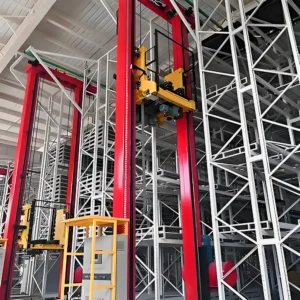
Automated Racksu00a0are storage systems designed to work with automated material handling equipment and warehouse control systems, helping businesses store, retrieve, and manage goods with less manual intervention.
By combining high-density storage structures with technologies such as stacker cranes, shuttle systems, conveyors, lifts, and warehouse management software, automated racking systems can improve storage efficiency, inventory accuracy, and warehouse throughput.
JULIu00ae provides automated rack solutionsu00a0for warehouses, manufacturing facilities, distribution centers, cold storage, and other operations where storage density, throughput, and inventory control are critical.
The rack structure, load capacity, aisle configuration, storage levels, and equipment interface can be developed according to the customer’s warehouse and material handling requirements.
Explore our Automated Rack collection to understand the available systems and find the right automation solution for your warehouse.
What Is an Automated Rack?
An Automated Racku00a0is a warehouse storage rack designed to operate as part of an automated storage and retrieval process.
Unlike a conventional rack where operators manually drive forklifts into storage aisles, automated racking systems use mechanical handling equipment and control systems to move goods between storage locations and workstations.
The complete process may include:
- Inbound
- Identification
- Transport
- Storage
- Retrieval
- Picking
- Outbound
Depending on the system, automation can involve:
Stacker cranes
Shuttle cars
Conveyors
Automated lifts
AGV or AMR integration
Warehouse Management Systems
Warehouse Control Systems
Barcode or RFID identification
The rack therefore becomes part of a larger automated warehouse system rather than functioning as an isolated storage structure.
How Do Automated Racks Work?
The exact operating process depends on the automation technology, but the basic principle remains the same.
Products arrive at the receiving area and are identified through the warehouse management system.
Conveyors, shuttles, stacker cranes, AGVs, AMRs, or other equipment transport the load toward the assigned storage location.
The automated handling equipment positions the pallet, container, or other load into the designated rack location.
The warehouse control system records the storage location, allowing inventory to be tracked digitally.
When a product is required, the system retrieves it from the assigned location and sends it to the required workstation or outbound area.
This reduces the need for operators to manually search for storage locations.
Key Advantages of Automated Racks
Automated systems can combine high rack heights with narrow operating aisles and automated handling equipment.
This can increase the amount of inventory stored within a given building footprint.
Automated equipment performs many repetitive storage and retrieval movements, reducing the need for manual forklift operations.
The system can associate products with defined storage locations and track movements through warehouse software.
Automated equipment can execute predefined storage and retrieval tasks efficiently, particularly in high-volume operations.
The storage layout can be designed around building height, rack dimensions, equipment travel paths, and required throughput.
Automated processes reduce dependence on individual operator decisions for routine storage and retrieval tasks.
When integrated with warehouse management software, product movements and storage locations can be recorded digitally.
Automation provides greater value when goods move frequently and in predictable processes.
In applications such as cold storage, automated equipment can reduce the amount of time personnel need to spend in demanding environments.
Why Choose JULI® for Automated Racking?
How to Plan an Automated Racking System
Custom Automated Racking Solutions
Every automated warehouse is different.
A high-bay pallet warehouse, a frozen-food distribution center, and a high-SKU e-commerce warehouse have completely different operating requirements.
Therefore, an automated rack should be designed according to:
Load Unit + Storage Capacity + Building + Throughput + Automation Equipment + Workflow
JULI® can support customized rack dimensions, load capacity, levels, structural configuration, and equipment interfaces according to the project.
For larger automation projects, rack engineering can be coordinated with the overall warehouse solution to ensure that storage structures and handling systems work together.