
Warehouse storage is rarely as stable as the building itself.
A food warehouse may be full of rice and flour during one season and need space for cooking oil, packaged goods, or beverages a few months later. An agricultural facility can receive large quantities of produce during harvest and operate with much lower inventory afterward. A beverage distributor may need extra space before a peak sales period and less space once orders have been shipped.
This is where stackable shelves storage becomes interesting.
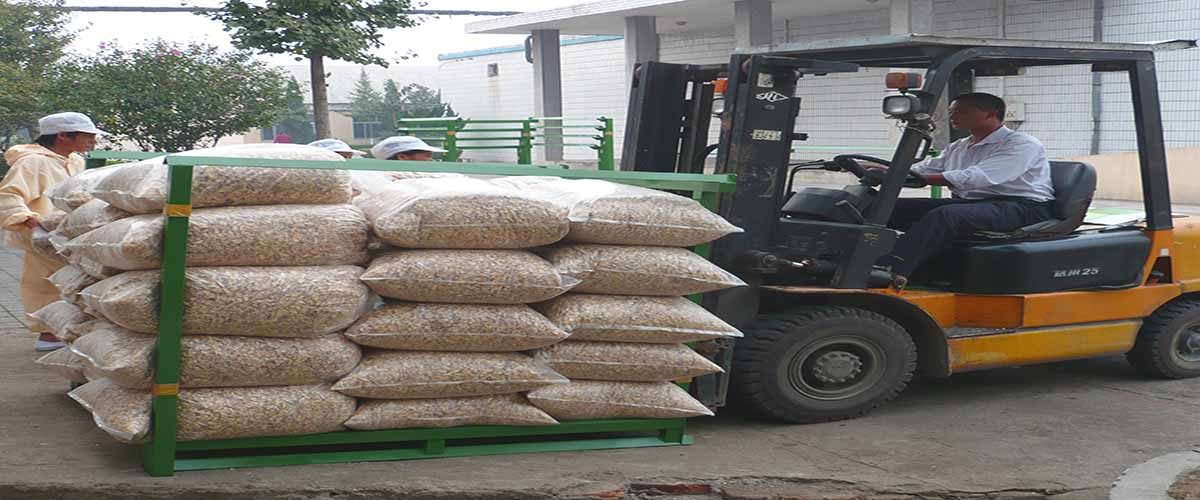
Instead of treating storage equipment as a permanent part of the warehouse layout, stackable storage allows the storage structure itself to move with the inventory. Individual steel units can be loaded, stacked, relocated, separated, or folded depending on their design and application.
The result is not simply “more shelves.” It is a storage method built around changing inventory, bulk products, and flexible material handling.
When Floor Space Is Not the Real Problem
Many warehouses focus on how much floor area they have.
The more important question is often:
How much of the available warehouse volume are you actually using?
Floor stacking keeps inventory concentrated at ground level. Once the usable floor area is occupied, adding more products becomes difficult even when considerable space remains above the goods.
This becomes especially noticeable with bagged and boxed products.
A warehouse storing flour bags, grain, animal feed, beverage cases, or agricultural products may have enough building volume but still run out of practical storage capacity because the goods cannot simply be piled indefinitely.
Stackable storage changes the equation by introducing a structural layer between the loads.
Instead of:
Product → Product → Product
the concept becomes:
Rack → Load → Rack → Load
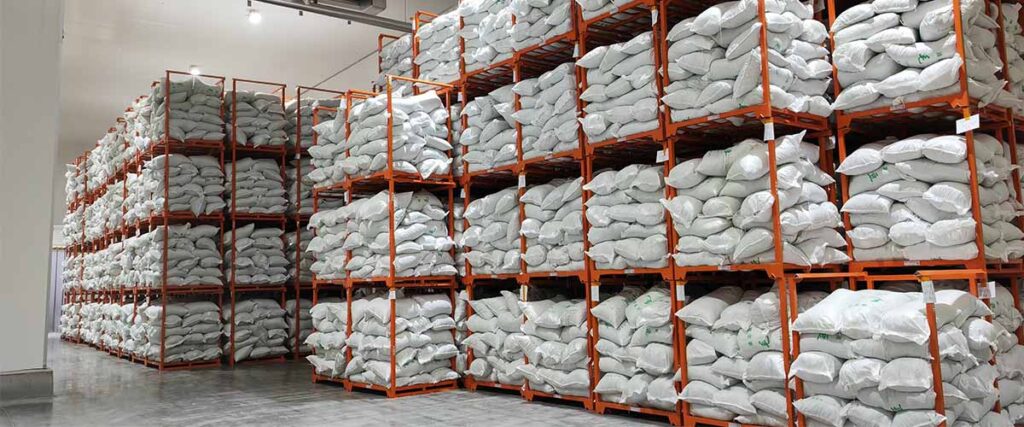
The steel structure carries the vertical load and creates defined stacking positions.
This is one reason stackable storage is often considered for warehouses that need higher-density storage without committing to a permanently installed rack layout. Current industry examples describe stacking racks as a way to use vertical warehouse volume while keeping the storage units movable.
The Real Advantage: Your Warehouse Can Change Without Rebuilding
A fixed rack layout assumes that tomorrow’s storage requirements will resemble today’s.
That assumption does not always work.
Consider an agricultural warehouse during harvest season. The facility may suddenly receive hundreds of bags, crates, or containers within a short period. Once the harvest period ends, that same floor area may be needed for sorting, packaging, equipment, or dispatch.
With stackable shelves storage, additional units can be introduced during the high-volume period and rearranged afterward.
The same principle applies to food distribution, beverage warehouses, manufacturing plants, and temporary storage areas.
This makes flexibility a more meaningful advantage than simply claiming that a rack “saves space.”
A Better Match for Products That Do Not Behave Like Boxes
Not every warehouse product fits neatly onto conventional shelving.
Some products are:
Soft and deformable
Heavy and bulky
Packed in large bags
Stored in cartons or cases
Transported in reusable crates
Loaded on pallets
Seasonal in volume
Difficult to pick individually
For these goods, the storage structure needs to reflect the way the product is actually handled.
Bags Need Structural Support
Rice, flour, grain, feed, seeds, and fertilizer are typical examples.
When bags are directly stacked, the lower layers gradually become part of the load-bearing structure. Excessive compression can affect package shape and make lower-level goods harder to retrieve.
A steel storage frame separates the load-bearing function from the product itself.
This is particularly useful where large quantities of bagged goods must be stored for extended periods.
Cartons Need Order, Not Just Height
For boxed goods, the challenge is often different.
A beverage warehouse, for example, may have multiple brands, package sizes, batches, and destinations occupying the same building.
Simply increasing the stacking height does not solve the problem of product identification.
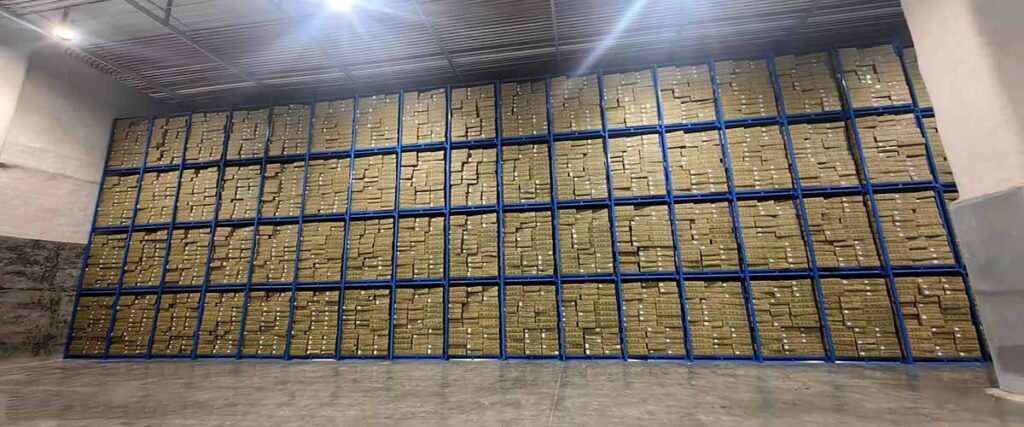
Independent storage units can create physical separation between product groups, making it easier to organize stock according to SKU, batch, customer, or dispatch schedule.
Crates Need Compatibility
Fruits and vegetables are frequently handled in plastic crates, bins, or reusable containers.
Their dimensions may differ from standard pallets, and airflow can be important for some products.
Rather than forcing these containers into a generic shelving format, the storage structure can be dimensioned around the crate itself.
This is one area where customized stackable shelves can provide more practical value than standard warehouse shelving.
From Rice Bags to Beverage Cases: One Storage Concept, Different Applications
The strength of this storage method is not that one rack can store everything.
It is that the same basic storage principle can be adapted to very different loads.
Rice, Flour and Grain
Dry food products are frequently stored in bags or palletized loads.
A suitable steel structure can provide a stable base while allowing multiple units to be positioned vertically.
For warehouses dealing with different bag weights, the rack should be designed around the actual unit load rather than using a generic capacity figure.
Edible Oil
Cooking oil may arrive in cartons, cases, drums, or containers.
The storage requirement therefore depends heavily on the package format.
For cartonized products, the emphasis may be on organized storage and forklift handling. Heavier containers may require a more substantial base structure.
Beer and Beverages
Beverage warehouses have a different operating rhythm.
Products often move rapidly from receiving to storage and then to outbound loading. Cases may also be returned, repacked, or temporarily staged.
Here, the value of movable storage is not only capacity. It is the ability to reorganize the warehouse around the flow of goods.
Other Bagged Products
The same principle applies to products such as animal feed, seeds, fertilizer, and other bagged materials.
Their packaging makes direct stacking possible, but repeated vertical loading can create problems with compression, access, and stock rotation.
A dedicated steel support structure can make the storage arrangement more controlled.
Boxed Goods
Cartons are easier to handle than bags but introduce another issue: product variety.
A distributor may have dozens or hundreds of SKUs occupying the same warehouse.
Using separate storage units can help create physical zones without installing a large permanent shelving system.
Fruits and Vegetables
Agricultural produce requires a different approach again.
Crates and bins may need to remain accessible, and certain products may benefit from open structures rather than enclosed storage.
During harvest, the amount of produce entering the facility can change dramatically from day to day.
That makes movable storage particularly useful for agricultural operations where capacity needs are temporary rather than constant.
The Warehouse Workflow Matters More Than the Rack
One mistake in storage planning is choosing the rack before understanding the movement of goods.
A better approach is to follow the product.
Receiving → Temporary Storage → Main Storage → Picking → Staging → Shipping
Then ask:
Where does the product arrive?
Is it already palletized?
Does it remain on the rack during internal transportation?
How frequently is it accessed?
Does the product change packaging?
Does inventory need to be separated by batch?
How often does the storage layout change?
This is where stackable storage can have an operational advantage.
If the loaded rack itself can be moved, the warehouse may eliminate some unnecessary transfers between pallets, storage locations, and staging areas.
Industry examples specifically position portable stacking racks as storage units that can remain with the cargo through different stages of handling, reducing unnecessary double handling.
That is a much stronger benefit than simply saying “easy to move.”
Seasonal Warehousing Is Where the Concept Becomes More Valuable
Permanent storage equipment is generally designed around relatively stable demand.
Agricultural warehouses often have the opposite situation.
During harvest:
Inventory ↑ → Storage requirement ↑
After the season:
Inventory ↓ → Storage requirement ↓
This creates a problem with fixed storage systems. A warehouse may invest in enough infrastructure for peak capacity and then leave part of that infrastructure underutilized for the rest of the year.
Stackable units can provide another option.
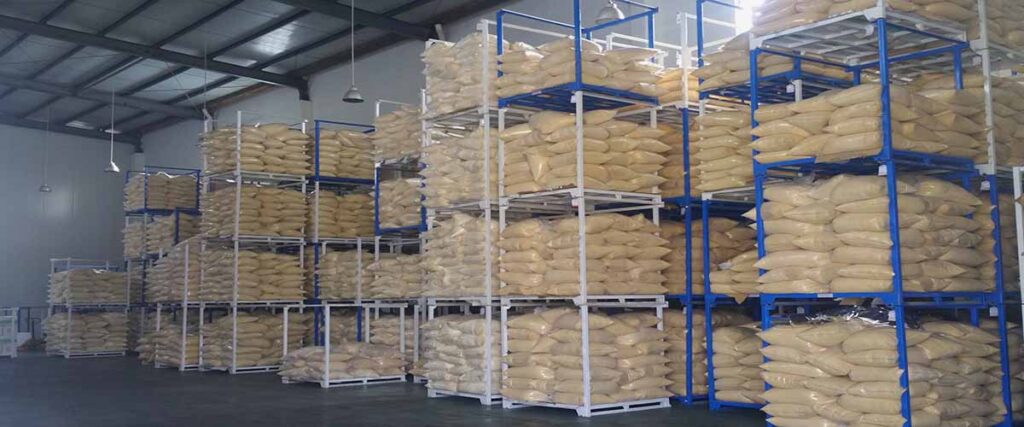
During peak periods, more units can be deployed. During quieter periods, the equipment can be separated, nested, folded, or moved to another area depending on its design.
Agricultural applications reported by manufacturers include seasonal storage of products such as onions, potatoes, rice seed, and other bulk agricultural goods.
For a business whose inventory follows the agricultural calendar, this flexibility can be more valuable than maximum storage density alone.
Why Folding and Detachable Designs Matter
Not every stackable storage unit needs to remain fully assembled when empty.
This is particularly important when the equipment itself has to travel.
Imagine a beverage distributor sending empty racks back to a supplier, or an agricultural business storing equipment between harvest seasons.
A rigid rack that occupies the same volume whether loaded or empty creates its own logistics problem.
Depending on the design, folding racks can reduce the empty volume, while detachable models can allow posts or frames to be removed and bases to be nested.
The purpose is simple:
Store products efficiently when loaded. Store the equipment efficiently when empty.
That second part is often overlooked in warehouse planning.
Choosing the Right Structure for the Load
There is no universal “best” stackable shelf.
The right configuration depends on the load.
| Product Type | Important Design Considerations |
| Rice & flour bags | Base support, load distribution, bag dimensions |
| Grain & feed | Unit weight, stacking height, seasonal demand |
| Edible oil | Carton/container dimensions, load capacity |
| Beer & beverages | Case dimensions, forklift access, handling frequency |
| Bagged materials | Compression protection, base structure |
| Cartons | Product separation, containment, accessibility |
| Fruits & vegetables | Crate size, ventilation, seasonal volume |
| Palletized goods | Pallet dimensions, fork entry, load capacity |
This is also why buying a rack based only on its advertised maximum load can be misleading.
A 1,000 kg capacity may be sufficient for one application and unsuitable for another if the load distribution, dimensions, or stacking configuration are different.
What Should Be Customized?
Customization does not necessarily mean redesigning every component.
Often, relatively simple changes can make the storage unit much better suited to the application.
Possible adjustments include:
Rack length and width
Overall height
Internal clearance
Base construction
Forklift entry
Post configuration
Mesh or steel panels
Removable components
Folding mechanisms
Surface treatment
For example, a rack designed for rice bags may prioritize a stable base and load distribution, while one for vegetable crates may prioritize open access and crate dimensions.
The goal is to make the equipment fit the load and workflow, not simply make a standard rack larger or stronger.
When Stackable Shelves Storage Is a Good Choice
This storage method is worth considering when several of the following conditions apply:
Inventory levels fluctuate.
Products are bulky or packaged in bags and cartons.
Forklifts are already used for internal handling.
Seasonal storage is important.
The warehouse cannot justify a permanent rack system for peak inventory.
Goods need to be separated into movable storage units.
Empty storage equipment must occasionally be relocated.
Products require structural support during vertical stacking.
It may be less suitable when goods require very high-frequency individual picking or when every SKU needs a permanent, dedicated picking position.
The objective is not to replace every type of warehouse racking.
It is to provide a better solution for the type of inventory that benefits from movable, stackable storage units.
Stackable Shelves Storage as Part of a Larger Material-Handling System
The rack itself is only one part of the operation.
A well-designed solution considers the relationship between:
Product + Rack + Forklift + Floor + Warehouse Layout + Inventory Flow
For example, a rack may have excellent load capacity but still perform poorly if the forklift cannot access it efficiently.
Similarly, a compact design may save floor space but create problems if operators cannot safely load or retrieve the goods.
For this reason, the design process should start with the actual operating conditions rather than a catalog model.
From Storage Equipment to a Reusable Logistics Asset
One of the more interesting aspects of stackable shelves storage is that the rack does not have to be treated as a stationary warehouse fixture.
It can become part of the material flow.
A loaded unit can move from:
Receiving → Storage → Production → Staging → Shipping
without necessarily requiring the goods to be unloaded at every stage.
For manufacturers and distributors handling repeatable product flows, this can turn the storage rack into a reusable logistics asset rather than simply a place where goods sit.
That distinction becomes particularly valuable when the same type of goods moves through the facility repeatedly.
How a Manufacturer Can Build the Right Solution
For industrial projects, the most useful information for a manufacturer is not simply:
“I need stackable shelves.”
The better starting point is:
What are you storing, how much does it weigh, how is it packaged, and how does it move through your warehouse?
A manufacturer can then evaluate:
Unit load
Product dimensions
Rack dimensions
Stacking requirements
Forklift type
Handling frequency
Warehouse environment
Seasonal storage requirements
Empty-rack storage
Shipping requirements
This approach is especially important when the application involves agricultural products, food and beverage products, or non-standard packaging.
Frequently Asked Questions
What is Stackable Shelves Storage?
Stackable shelves storage is a flexible storage method in which individual steel storage units are designed to stack vertically. The units can typically be moved by forklift and rearranged according to warehouse requirements.
Is stackable storage suitable for bagged goods?
Yes. It can be particularly useful for products such as rice, flour, grain, animal feed, seeds, and fertilizer because the steel structure can provide support during vertical storage instead of relying entirely on the bags below.
Can it be used for fruits and vegetables?
Yes. The structure can be adapted for agricultural crates, bins, and containers. For some produce, open or mesh configurations may be preferable.
Can the same storage system be used for beverages?
Yes, provided the rack is designed for the dimensions and weight of the beverage cases, cartons, pallets, or containers being handled.
Are folding racks useful when empty?
They can be. A folding design can reduce the volume occupied by empty equipment, which can be useful in return logistics or seasonal operations.
How high can stackable storage units be stacked?
The permitted stacking height depends on the specific rack design, load, floor conditions, and operating environment. It should be established by the manufacturer rather than assumed from the rack’s appearance.
Conclusion
Stackable shelves storage is not simply another way to put products on shelves.
Its real value lies in giving the warehouse a storage structure that can adapt to the way inventory actually changes.
For a rice warehouse, that may mean handling large volumes of bagged products during peak periods. For a beverage distributor, it may mean reorganizing storage around changing shipments. For an agricultural operation, it may mean expanding capacity during harvest and reducing it afterward. For boxed or palletized goods, it can provide movable storage units that simplify organization and handling.
The best solution is therefore not necessarily the rack with the highest capacity or the greatest stacking height.
It is the one that fits the product, handling equipment, warehouse workflow, and changing storage demand.
For manufacturers and warehouse operators looking for a flexible alternative to permanent storage structures, properly engineered stackable shelves storage can turn unused vertical volume into practical storage capacity while keeping the warehouse adaptable.