
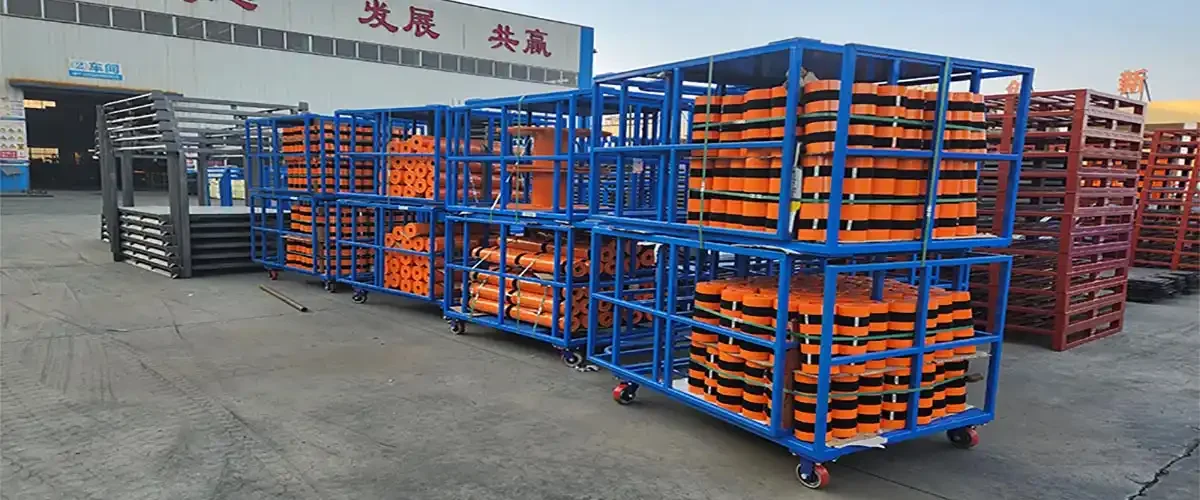
Automotive parts are rarely uniform. Engines are heavy, bumpers are bulky, body panels require careful separation, tires have an unusual shape, and exhaust components can be long and difficult to organize. As a result, standard warehouse shelving is not always the most practical way to store or move them.
This is where automotive racks become useful. Rather than using the same storage structure for every component, automotive racks can be configured around the size, weight, shape, protection requirements, and handling process of individual parts.
Depending on the application, the solution may include stacking racks, folding racks, pipe racks, or customized steel structures. The same rack can also serve different functions across the supply chain, from warehouse storage to production staging and parts transportation.
Why Automotive Parts Need Specialized Racks
The challenge in automotive storage is not simply the amount of inventory. It is the variety of the parts and the way those parts move.
A typical automotive warehouse may handle heavy powertrain components alongside large body panels, fragile glass, tires, long exhaust components, and smaller packaged parts.
Each creates a different storage problem.
Heavy components need a load-bearing structure that remains stable during forklift handling. Large painted parts need clearance and separation to prevent contact damage. Long components need support along their length, while smaller items may need dividers or dedicated containers.
A properly designed automotive rack provides a structured storage location for the part while taking its physical characteristics into account.
Automotive Racks for Different Types of Auto Parts
The most practical way to choose an automotive rack is to start with the part being stored.
| Automotive Part | Recommended Rack Approach | Main Requirement |
|---|---|---|
| Engines & transmissions | Stacking racks | Load capacity and stable support |
| Bumpers & fascias | Custom rack / folding rack | Shape and surface protection |
| Doors & body panels | Custom rack | Separation and clearance |
| Tires & wheels | Stacking or tire rack | Shape and easy handling |
| Windshields & glass | Specialized rack | Separation and protected contact |
| Exhaust pipes | Pipe rack | Long-load support |
| Axles & driveshafts | Pipe or stacking rack | Length and weight |
| Small components | Rack with partitions | Organization and accessibility |
This part-specific approach is one of the main differences between general-purpose warehouse storage and automotive storage equipment.
Stacking Racks for Heavy and Bulky Components
Stacking racks are useful when relatively large or heavy automotive parts need to be stored vertically.
Each unit provides its own structural support, allowing compatible racks to be stacked without placing the entire upper load directly on the product underneath.
This can be useful for:
- Engines
- Transmissions
- Axles
- Metal components
- Tires
- Automotive assemblies
- Returnable containers
The rack can be designed around the dimensions and weight of the component, with forklift access incorporated into the structure.
For warehouses handling fluctuating inventory, individual units can also be moved or rearranged without rebuilding a permanent storage layout.
The allowable stacking height depends on the rack design, load, floor conditions, and operating environment. It should be established according to the manufacturer’s engineering specifications.
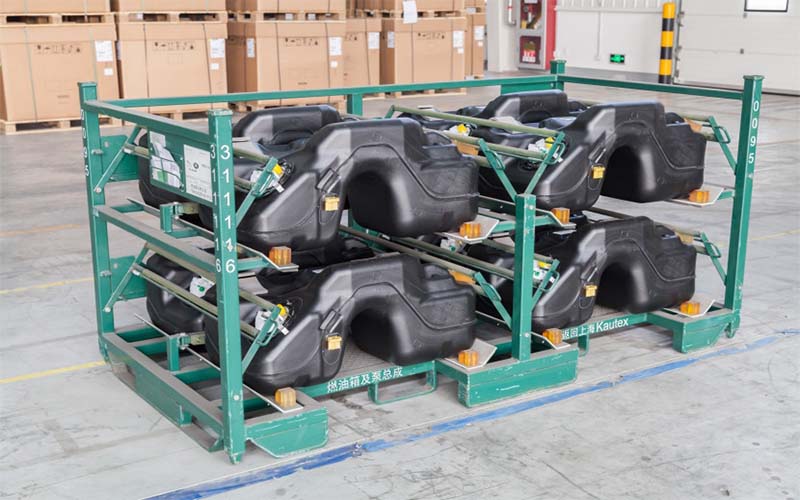
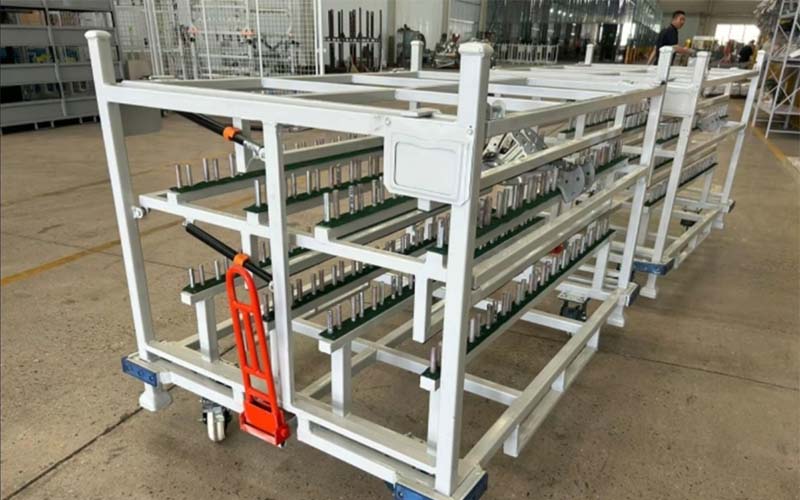
Folding Racks for Automotive Shipping and Return Logistics
Not all automotive racks spend their entire life inside a warehouse.
Many components move repeatedly between suppliers, distribution centers, and assembly plants. When the parts have been delivered, the empty rack has to return.
This is where folding racks can offer an advantage.
When loaded, the rack provides a stable structure for storing and transporting the parts. When empty, the frame can be folded or collapsed according to its design to reduce the space occupied during return transportation.
The basic logistics cycle becomes:
Load → Ship → Unload → Fold → Return
This approach is particularly relevant to returnable automotive packaging, where the same rack may be used repeatedly rather than treated as disposable transport equipment.
For suppliers shipping components to OEM plants, reducing empty-rack volume can be an important part of the overall logistics calculation.
Pipe Racks for Long Automotive Components
Long components create a different storage challenge.
Exhaust pipes, driveshafts, axles, tubing, and similar products can occupy considerable floor space when stored randomly or placed on shelves that do not match their geometry.
Pipe racks provide multiple support points along the component and can be designed around its length and load distribution.
The configuration may include:
- Multiple horizontal support levels
- End stops
- Separators
- Forklift entry points
- Protective contact surfaces
A pipe rack designed for exhaust components may not require the same support spacing as one intended for heavier shafts or axles.
The important factor is to design the rack around the actual component rather than treating every long part as the same type of load.
Protecting Automotive Parts During Storage
For many automotive components, preventing damage is just as important as providing storage capacity.
Painted parts, glass, trim, and finished body components can be damaged by repeated contact with neighboring products or the steel frame.
That is why automotive racks can incorporate part-specific protection such as:
Dividers
Separators create individual positions for components and reduce part-to-part contact.
Dunnage
Custom dunnage can follow the shape of a component and help keep it securely positioned.
Rubber or Soft Contact Points
Protective surfaces can reduce direct contact between steel and finished components.
Dedicated Cradles
Heavy or irregular parts may require shaped supports to maintain their position during storage and transportation.
This approach is particularly important when the rack will be used for both storage and shipping.
Automotive Racks for Storage, Staging and Shipping
An automotive rack can perform several roles within the same production and logistics process.
A supplier may load parts into a rack at the manufacturing facility, move the rack to a staging area, ship it to a customer, and then use the same rack for line-side storage after delivery.
The rack therefore becomes part of the material flow rather than simply a stationary storage fixture.
A typical process may look like:
Production → Staging → Storage → Shipping → Receiving → Line-Side Handling
This is especially useful when the component does not need to be unpacked and repacked between every stage.
For automotive manufacturers and suppliers, reducing unnecessary handling can make a bigger operational difference than simply increasing storage density.
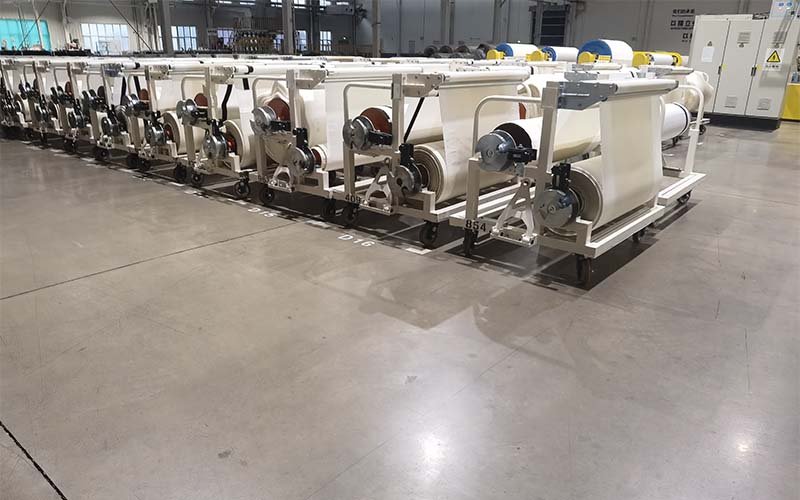
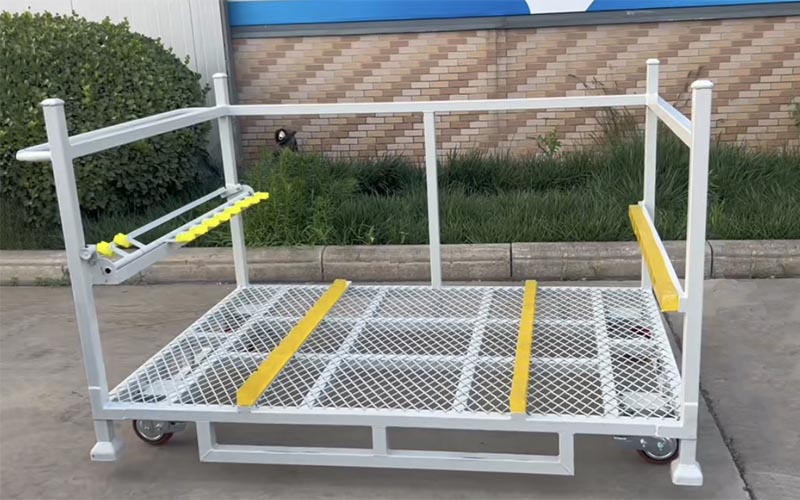
Automotive Racks for Line-Side Material Handling
The distance between warehouse storage and the assembly line can create unnecessary movement if parts need to be transferred between different storage containers.
A rack designed for line-side use can keep components organized and ready for production.
For example:
- Engines can remain in dedicated support racks.
- Body panels can remain separated in protective structures.
- Exhaust components can stay organized on pipe racks.
- Tires can remain in suitable stackable units.
This allows the storage equipment to become part of the production workflow.
Returnable Automotive Racks for Supply Chains
Automotive supply chains often involve repeated movement between the same facilities.
A rack may travel:
Supplier → OEM → Supplier
or:
Supplier → Distribution Center → Assembly Plant → Return
For this type of operation, rack durability, handling, empty-rack storage, and transport efficiency all matter.
A returnable automotive rack can be designed for repeated use rather than a single shipping cycle.
Stackable designs can help when the racks are loaded, while folding or detachable structures can reduce empty volume during return transportation.
This combination can make the rack a reusable logistics asset rather than simply a warehouse storage product.
How to Match Automotive Racks to the Handling Process
The right automotive rack is determined by more than the part itself.
The handling method also matters.
Before choosing a rack, consider:
How is the part loaded?
Manual loading and forklift loading create different design requirements.
Where is the part stored?
Warehouse storage may prioritize capacity, while line-side storage may prioritize access.
How often does it move?
A frequently transported rack requires a different design from a rack that stays in one location.
Does the rack travel outside the facility?
Shipping racks need to account for transport and repeated handling.
What happens when the rack is empty?
For returnable logistics, empty-rack volume can be just as important as loaded capacity.
These questions often determine whether a stacking, folding, pipe, or customized rack is the best solution.
Custom Automotive Racks for Specific Components
Standard dimensions are not always suitable for automotive parts.
A manufacturer can customize the rack around the actual component and handling process.
Typical customization may include:
| Design Element | Why It Matters |
|---|---|
| Rack dimensions | Match part size |
| Load capacity | Support component weight |
| Support positions | Follow part geometry |
| Forklift entry | Match handling equipment |
| Dividers | Separate individual parts |
| Dunnage | Protect finished surfaces |
| Folding structure | Reduce empty volume |
| Stackable design | Increase vertical storage |
| Pipe supports | Handle long components |
| Surface finish | Suit operating environment |
For example, a bumper rack may require wide openings and soft supports, while an engine rack may require a reinforced base.
A pipe rack may need several support points along the length of the component, whereas a body-panel rack may require more attention to separation and surface protection.
Automotive Racks for OEMs and Parts Suppliers
Different participants in the automotive supply chain may use the same basic rack concept in different ways.
OEM Assembly Plants
Racks can support receiving, staging, line-side delivery, and component handling.
Tier 1 and Tier 2 Suppliers
Suppliers can use racks for production storage, finished-part storage, and shipment to OEM customers.
Automotive Distribution Centers
Distribution operations may need flexible storage for replacement parts and mixed inventories.
Aftermarket Operations
Replacement components often differ significantly in size and shape, making customized storage useful for organizing non-standard products.
The correct rack configuration depends on the actual workflow rather than the company type alone.
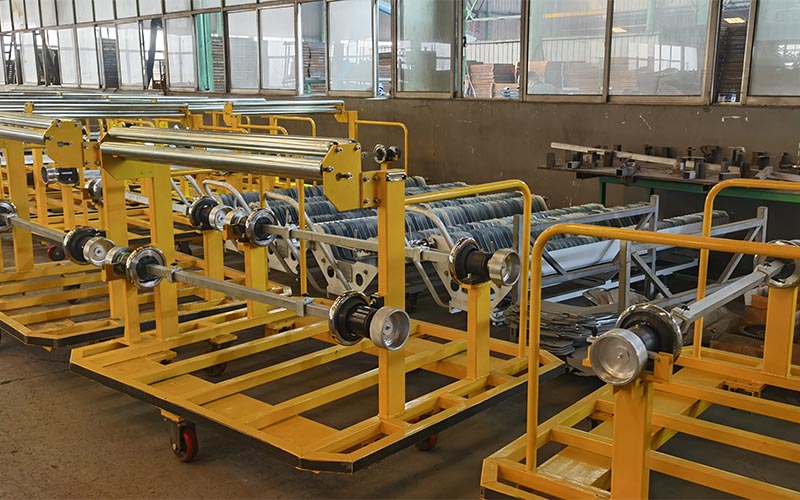
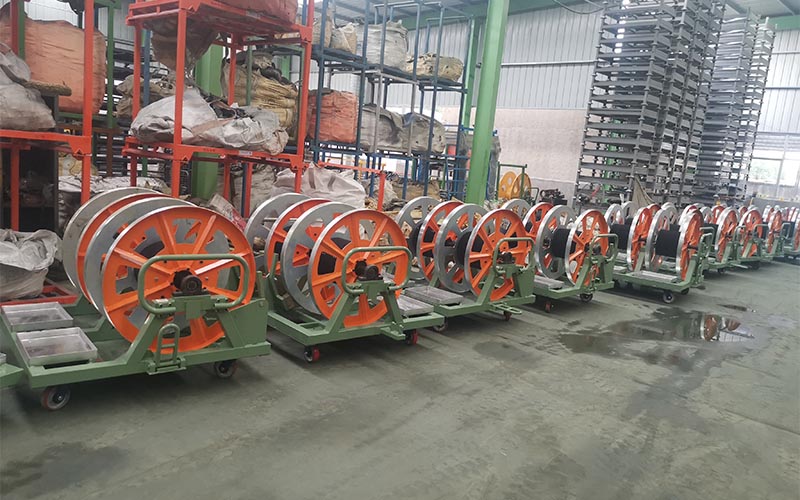
Why Steel Is Commonly Used for Automotive Racks
Automotive racks are subjected to repeated loading, unloading, stacking, forklift handling, and sometimes transportation.
Steel provides the structural strength needed for these applications while allowing manufacturers to fabricate customized frames, supports, panels, and attachments.
The objective is not to make every automotive rack as heavy as possible.
Instead, the structure should provide the required strength and stability while remaining practical to handle, transport, and use.
Automotive Racks vs. Conventional Warehouse Shelving
Conventional shelving is generally designed around standard shelf dimensions and relatively small packaged products.
Automotive racks are more often designed around the component itself.
| Consideration | Automotive Racks | Conventional Shelving |
|---|---|---|
| Product shape | Customized to component | Standard shelf format |
| Heavy components | Suitable with engineered structure | Often limited |
| Large parts | Better suited | Often inefficient |
| Long components | Specialized support possible | Limited |
| Part protection | Dunnage/dividers can be integrated | Usually basic |
| Forklift handling | Common | Application dependent |
| Shipping use | Possible | Usually not the main purpose |
| Return logistics | Folding/stackable options | Limited |
This is why automotive storage often requires a different approach from general warehouse shelving.
What to Consider Before Ordering Automotive Racks
Before requesting a quotation, collect the information that determines the rack design.
The manufacturer will typically need:
- Part name and function
- Part dimensions
- Maximum part weight
- Number of parts per rack
- Required storage height
- Forklift information
- Whether the rack will be shipped
- Whether the rack must be stackable
- Whether empty racks need to fold or collapse
- Protection requirements
- Expected operating environment
Photos, product drawings, packaging information, or an existing rack sample can also help the manufacturer develop a more accurate design.
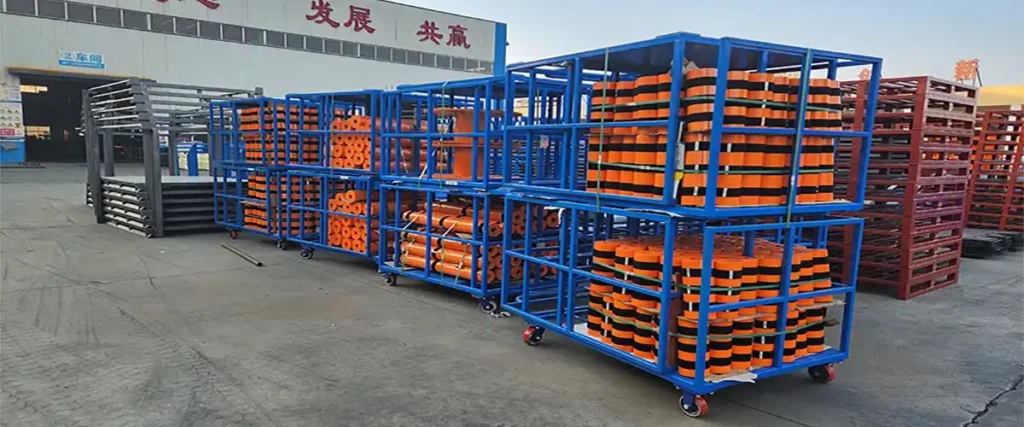
Frequently Asked Questions
What are automotive racks used for?
Automotive racks are used to store, handle, stage, and transport vehicle components such as engines, transmissions, bumpers, body panels, tires, glass, exhaust parts, and other assemblies.
Are stacking racks suitable for automotive parts?
Yes. Stacking racks can be designed for heavy or bulky automotive components and allow compatible units to be stored vertically.
When should I use a folding rack?
Folding racks are particularly useful when racks are repeatedly transported between facilities and empty units need to be returned while occupying less space.
What automotive parts can be stored on pipe racks?
Pipe racks are suitable for long components such as exhaust pipes, driveshafts, axles, tubing, and other elongated parts.
Can automotive racks be used for shipping?
Yes. Automotive racks can be designed for repeated transportation between suppliers, warehouses, distribution centers, and assembly plants.
Can automotive racks be customized?
Yes. Rack dimensions, supports, dividers, dunnage, forklift access, stacking features, folding structures, and other components can be customized according to the application.
Conclusion
The right automotive racks are determined by the parts they handle and the way those parts move through the supply chain.
Heavy engines and transmissions may benefit from stacking racks that provide independent structural support. Bumpers and body panels may require customized supports and protective separation. Long components such as exhaust pipes and shafts can be better suited to pipe racks, while folding racks can simplify return transportation when the equipment is used repeatedly between suppliers and production facilities.
For automotive manufacturers, OEMs, Tier 1 and Tier 2 suppliers, and distributors, the most effective rack is not necessarily the largest or strongest one. It is the configuration that matches the component, handling method, storage location, and shipping cycle.
That is why a well-designed automotive rack should be considered part of the material-handling process rather than simply another piece of warehouse equipment.