Introduction to Stackable Metal Racks in Modern Warehousing
In a global supply chain where speed is key, warehouse and logistics operations are constantly facing tough trade-offs. On the one hand, rising property costs are squeezing the floor space where the warehouse manager has to work with. On the other hand, a warehouse must ensure a high degree of protection for the entire range of stored goods together with stock movement and a workplace totally safe for the workers as the major points of its operations. The problem is that the use of conventional shelving and placing everything flat on the floor is often the main reason of the failures especially for industrial facilities handling loads such as heavy, non-uniform, or rolling goods.
A simple wooden pallet is not able to properly contain even a coiled power cable, an industrial rubber tyre, a heavy steel coil or bulk packaging of chemicals. When such things are carelessly stacked they will be sure to roll over, shift sideways or totally collapse.
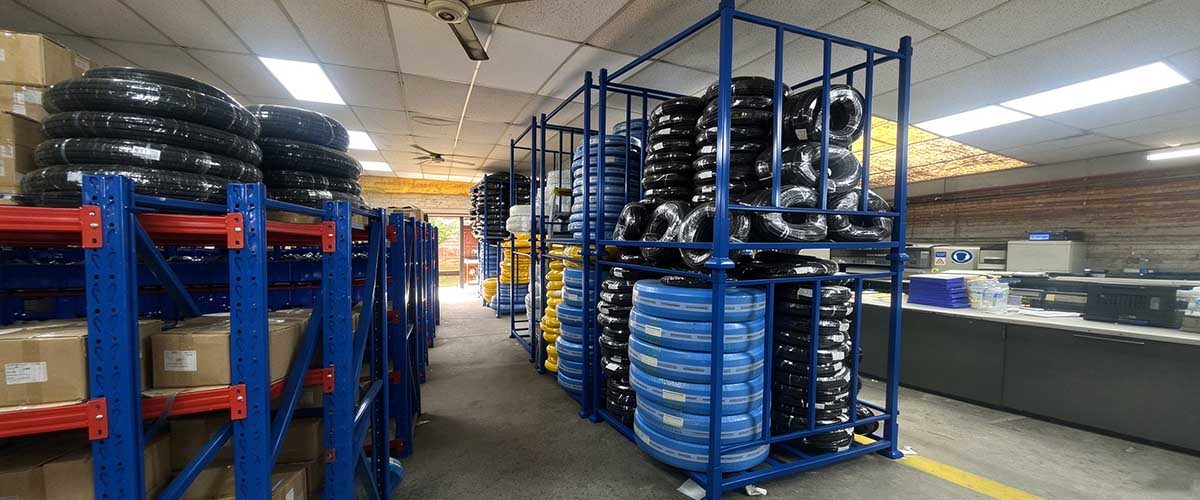
In order to tackle these kinds of operational bottlenecks, stackable metal racks have rapidly become the number one storage solution preferred by industrial facilities around the world. By design, these systems integrate enormous load-holding capability with intelligent vertical stacking features that make it possible for the chaotic warehouse floor layout to be transformed into organized, maximized height storage.
This article outlines the major reasons for design and the working principles for a successful deployment of stackable metal racks from an equipment and facilities side. It also explains how various industries apply this technology and what positive operational changes such introduction has generated across the globe.
In short, it shows the warehouse operator the ways the different kinds of stackable metal racks can resolve different types of operational problems.
Engineering Design & Structural Innovations of Stackable Metal Racks
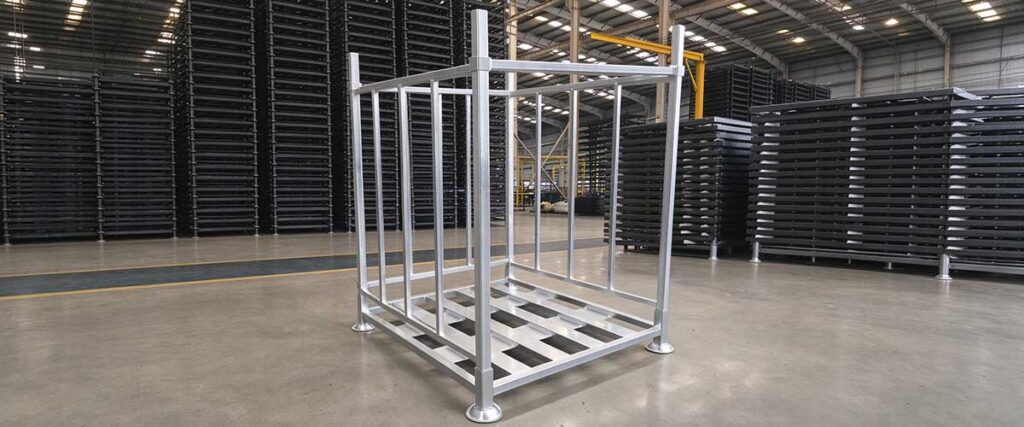
The precise dimensions of $1250 \times 1250 \times 1700\text{ mm}$, a lightweight self-weight of $75\text{ kg}$, and an impressive working load capacity of $1.2\text{ to }1.5\text{ tons}$ make these stackable metal racks uniquely versatile. Their structural design incorporates four key mechanical innovations:
Three-sides fence plus frontless of stackable metal rack.
Three-sided vertical steel tubing fence: The three-sided fencing system with vertical steel tubing totally prevents any chance of moving and shifting of cargo during rolling. At the same time, the totally open front makes it possible for fork lift operators to load and unload heavy cargo very quickly without having to open or close safety hatches, thereby ensuring very high-frequency operation.
Four Corner Stacking Feet & Interlocking Basins
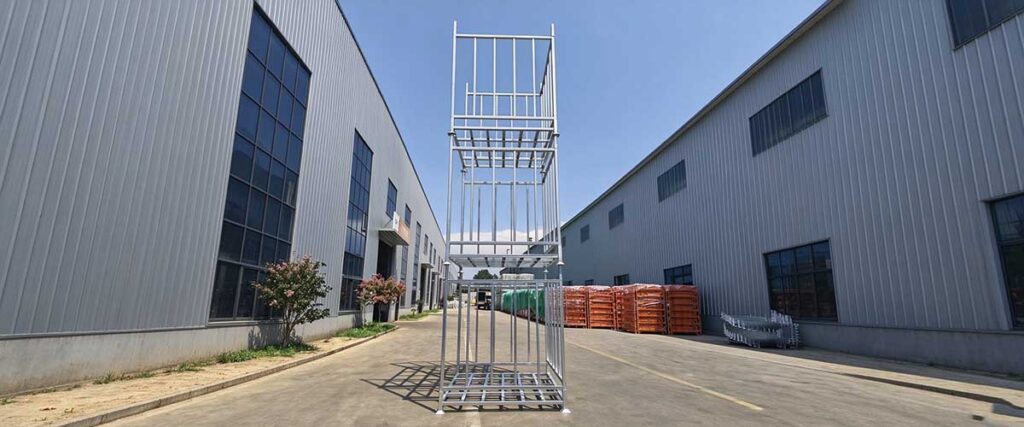
The design is such that, once lifted, a unit locks with another via a stacking cup on the top and a pointed tapered foot at the bottom. This makes it possible for facilities to safely stack stackable metal racks up to four levels tall while still making good use the headspace. The units can then be unstacked to take up less floor space when there are no goods inside.
Reinforced Base for Stackable Metal Racks Handling Heavy Loads
Stackable metal racks’ main structural support is not a grid of slats but a grid-welded box-profile steel base. Point loads are distributed, rigidity improved, and aeration/dewatering/moisture resistance is achieved through this base.
Square Tubing of Main Frame in Stackable Metal Racks
The cage is welded from high-grade industrial-grade square steel tubing to form the main frame of the stackable metal rack. Stackable metal racks remain totally stable even in the face of several ton loads from multi-tier stacking, i.e., without warping, or shearing.
Material Science and Environmental Resilience of Stackable Metal Racks
Stackable metal racks have to have extremely durable materials when they are in places like marine ports, humid warehouses, chemical production sites, and cold storage.
Corrosion-resistant Protection: Before powder coating is applied, stackable metal racks undergo intense chemical cleaning, pickling, and phosphating preparatory processes.
Scratch-resist: Stackable metal racks’ tough surface protects the metal from scratches that could be due to forklift fork and even during rough handling of the racks, the paint surface remains intact.
Water Drainage and Temperature Resistance: The open grid floor of stackable metal racks facilitates drainage and prevents the accumulation of stagnant water, making these storage devices ideal for use in cold rooms or temporary outdoor storage.
Industry-Specific Applications and Cargo Types for Stackable Metal Racks
Stackable metal racks serve a diverse range of cargo types and industrial sectors:
Wire and Cable Industry Applications
Cargo: Coiled electric cables, heavy wire spools, optical fiber drums, and coiled wire rods.
Value: Stackable metal racks eliminate cable tangling and roll-overs while allowing individual rack retrieval without disturbing neighboring units.
Food, Beverage, and Cold Chain Storage
Cargo: Bulk grains, edible oils, flour bags, frozen meat blocks, and beverage cartons.
Value: Stackable metal racks keep perishable items elevated off damp floors, promote optimal cold air circulation, and streamline FIFO inventory rotation.
Paper, Printing, and Packaging Solutions
Cargo: Giant paper rolls, corrugated tubes, plastic film rolls, and adhesive tapes.
Value: Stackable metal racks protect delicate roll edges from friction damage and organize stock by weight and diameter.
Plastics, Rubber, and Automotive Tires
Cargo: Extruded plastic coils, industrial rubber sheeting, heavy truck/car tires, and hydraulic hoses.
Value: Stackable metal racks prevent tire ovalization and flattening under heavy stacking pressure.
Automotive Parts and Heavy Manufacturing
Cargo: Stamping dies, precision injection molds, heavy fixtures, and raw casting components.
Value: Stackable metal racks act as secure, mobile modular bays for heavy tooling, allowing easy transport between workstations via forklift or crane.
Global Adaptability of Stackable Metal Racks:
Supply chain conditions vary across the globe, yet stackable metal racks offer broad applicability. In Southeast Asia, they effectively protect goods against humidity and monsoon moisture while maximizing limited space in urban factories. In Europe, they meet stringent health and safety standards and align with circular economy leasing models. In North America, they integrate seamlessly into rapid delivery channels and large-scale forklift-based logistics networks. In South America, they provide solutions for the challenging cold-chain transport of meat and the large-scale distribution of tires and agricultural produce. In Africa, they offer robust, maintenance-free storage structures for rapidly expanding commercial trade hubs.
Conclusion: Transform warehouses with stackable metal racks.
These racks replace disorganized pallet stacking with orderly, high-density vertical storage systems. They perfectly combine exceptional load-bearing capacity (1.1–1.2 tonnes), multi-level stacking capabilities (up to four tiers), and unmatched safety. For modern facilities aiming to optimize space utilization and enhance inventory protection through racking systems, adopting stackable metal racks represents a crucial strategic investment.