
Choosing the right warehouse storage solutions is not simply about adding more racks. Different products require different ways to store, handle, and move them. Palletized goods need reliable forklift access, bagged products need stable support, and seasonal agricultural inventory may require storage capacity that changes throughout the year.
For manufacturers, distributors, agricultural businesses, food and beverage companies, and logistics operators, a practical warehouse may combine stacking racks, pallet racks, folding racks, and metal pallets according to the products and workflow.
The goal is to make better use of available space while keeping products accessible and material handling efficient.
What Should a Warehouse Storage Solution Solve?
A good storage solution starts with the goods rather than the rack.
Consider a warehouse storing rice, flour, beverage cases, agricultural crates, automotive parts, and finished products. These goods do not have the same dimensions, weight, packaging, or handling requirements.
Some products are palletized and moved frequently by forklift. Others arrive in bags or cartons and are better suited to bulk storage. Seasonal goods may require additional capacity for only part of the year.
This is why warehouse storage solutions should be planned around four basic factors:
| Consideration | What to Evaluate |
| Product | Size, weight, packaging and shape |
| Inventory | Average volume, peak volume and seasonality |
| Handling | Forklift, pallet truck or manual handling |
| Storage | Stacking, pallet access, mobility and layout |
The objective is not to install one rack type throughout the warehouse. It is to assign the right storage method to each type of inventory.
Stacking Racks, Pallet Racks and Folding Racks
Three types of steel storage equipment can solve very different warehouse problems.
Stacking Racks for Flexible Bulk Storage
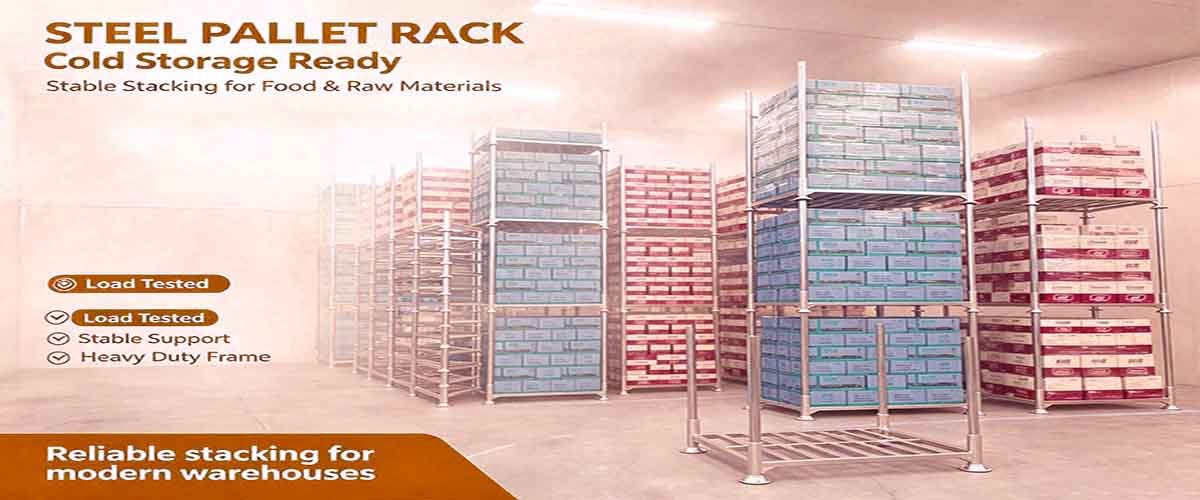
Stacking racks are useful for products that need vertical storage but do not necessarily require permanent rack positions.
They can be used for bags, cartons, containers, bulky components, and other loads that benefit from independent structural support. Because each unit can be handled separately, warehouses can also adjust storage areas according to production schedules or inventory levels.
For example, rice bags, flour, animal feed, agricultural products, and industrial components can be stored on stacking racks instead of relying entirely on product-on-product stacking. The rack dimensions and load capacity can also be adapted to different products.
Pallet Racks for Palletized Goods
Pallet racks are more appropriate when goods are already loaded onto standard pallets and individual pallet positions need to remain accessible.
They can be used for finished products, packaged food, beverages, raw materials, and other palletized inventory. This arrangement makes it easier for forklift operators to place and retrieve specific pallet loads without disturbing neighboring positions.
The rack dimensions should be matched to the pallet size, load, forklift equipment, and available aisle space. For facilities with different pallet formats, the rack layout can also be planned around the most frequently handled load units.
Folding Racks for Returnable and Seasonal Storage
Folding racks solve a different problem.
When loaded, they provide a dedicated storage and handling structure. When empty, the rack can be folded or collapsed, depending on the design. This can reduce the space required for empty equipment and make return transportation easier.
This can be useful when racks move between facilities, support returnable logistics, or are only needed during seasonal peaks. Agricultural businesses, automotive suppliers, and distribution operations can all benefit when storage equipment itself needs to move as part of the logistics process.
The principle is simple:
Use the rack efficiently when loaded, and minimize the space it occupies when empty.
Together, these three types of equipment allow a warehouse to use different storage methods without forcing every product into the same system.
Warehouse Storage Solutions for Agriculture, Food and Bulk Goods
Agriculture and food-related warehouses often have changing inventory and different packaging formats, making flexible storage particularly useful.
Rice, Grain and Flour
Rice, grain, flour, and similar products are commonly stored in bags.
A steel storage structure can keep the bags organized, support vertical storage, and reduce dependence on uncontrolled floor stacking. It can also create clearer storage areas for different product types, bag sizes, or batches.
For seasonal agricultural warehouses, stacking racks can be added during high-volume periods and reorganized when inventory decreases. This gives the warehouse more flexibility than designing the entire storage area around peak-season demand.
Fruits and Vegetables
Fresh produce is often handled in crates, bins, or reusable containers.
Instead of using one standard shelf size, the storage structure can be designed around the crate dimensions. Open or mesh configurations can also be considered where easy access and airflow are important.
For farms, collection centers, and produce distributors, storage requirements can change rapidly during harvest. Movable storage units can therefore make it easier to increase capacity temporarily without permanently changing the warehouse layout.
Beer and Beverages
Beverage warehouses may handle cartons, cases, bottles, cans, and pallets at the same time.
Pallet racks can support palletized inventory, while stacking racks or other portable units can be used for bulk or temporary storage. The appropriate solution depends on the package format, load weight, turnover rate, and handling process.
Folding racks can also be useful where reusable storage equipment needs to return to a supplier or distribution center after unloading. This can be particularly useful in closed-loop logistics where the same storage equipment is used repeatedly.
Other Bagged and Boxed Goods
The same principle applies to animal feed, seeds, fertilizer, packaged food, cartons, and other bulk products.
Bagged goods may benefit from structural support during stacking, while boxed goods may require clearer separation by product type, batch, or customer order. A warehouse can therefore combine different storage configurations without creating an entirely separate system for every product.
The storage structure should match the load rather than making every product fit the same rack.
How to Choose the Right Warehouse Storage Solution
The right solution depends on how the warehouse operates.
Choose by Product
Start with the product dimensions, weight, packaging, and whether it can be stacked directly.
Also consider whether the product is fragile, irregularly shaped, packaged in bags or cartons, or stored in reusable containers. These details can determine whether a pallet-based, rack-based, or customized storage method is more practical.
Choose by Handling Method
If forklifts move most of the inventory, rack entry, pallet dimensions, aisle width, and lifting height become important.
The storage equipment should match the actual handling process rather than forcing operators to change their existing equipment. Forklift entry, load distribution, and the frequency of movement should all be considered during design.
Choose by Inventory Changes
A warehouse with stable inventory may need a different layout from a facility where stock changes significantly by season or customer order.
This is particularly important in agriculture, food distribution, and logistics, where peak inventory can be much higher than average inventory. Flexible storage equipment can help avoid designing the entire facility around a short-term peak.
Choose by the Complete Workflow
Look at the whole process:
Receiving → Storage → Production or Picking → Staging → Shipping
A rack that can remain with the load through several stages may reduce unnecessary handling. In some operations, the storage unit itself can become part of the internal material flow rather than simply remaining in one warehouse position.
Consider the Empty Equipment
For folding or returnable storage equipment, the empty condition matters too.
If racks must be transported back to another facility, a folding or detachable design may reduce the volume occupied during return transportation. This can be important for businesses that operate reusable racks in supplier-to-customer logistics or seasonal storage cycles.
Custom Warehouse Storage Solutions for Industrial Applications
Standard storage products work for many applications, but industrial customers often require different dimensions, capacities, or handling configurations.
A custom warehouse storage solution can be designed around:
Product dimensions
Load requirements
Forklift access
Stacking height
Pallet size
Internal supports
Panels or partitions
Folding or detachable structures
Surface treatment
For example, an agricultural warehouse may need racks for bags and crates, while a manufacturing facility may require customized units for components or work-in-process materials. A logistics operation may instead prioritize pallet compatibility, handling efficiency, and container loading.
The most useful customization is not simply changing the rack size. It is adapting the equipment to the way the product is stored and moved.
Conclusion
Effective warehouse storage solutions should match the products, inventory patterns, and material-handling process rather than relying on one storage method for every application.
Stacking racks provide flexible storage for bulk and irregular goods. Pallet racks organize palletized inventory, while folding racks can support seasonal and returnable logistics. Combined with reusable metal pallets, these products can form a practical steel storage system for manufacturing, agriculture, food and beverage, and logistics operations.
For warehouses with changing inventory or non-standard products, a customized solution can provide a better balance between storage capacity, accessibility, and operational flexibility.