Introduction: The Hidden Cost of Inefficient Warehouse Storage
If you walk into a modern distribution center, automotive assembly plant, or third-party logistics (3PL) warehouse, you will likely notice a familiar struggle: floor space is shrinking, while SKU diversity and handling costs are climbing.
According to global supply chain warehousing statistics, industrial real estate vacancy rates remain historically tight, driving storage costs upward. Facility managers are under intense pressure to maximize every square foot of cubic volume without expanding their physical footprint.
For decades, the default response was traditional selective pallet racking bolted directly into concrete. While effective for permanent, high-SKU picking, static racks lack operational agility. When seasonal inventory surges hit, fixed racks cannot scale. When inventory drops during slow quarters, empty racks continue to devour valuable square footage.
This operational bottleneck is why industry leaders are shifting toward stacking racks for warehouse operations—specifically fixed, heavy-duty nestable stacking racks (Nestainers). Blending the structural strength of permanent steel shelving with the ultimate mobility of portable containers, stacking racks are redefining modern industrial storage.
In this guide, we will break down the engineering principles, real-world operational benefits, safety compliance standards, and why integrating stacking racks can dramatically lower your operational costs and drive high-value B2B inquiries.
1. What Are Stacking Racks and How Do They Work?
Stacking racks for warehouse deployment (commonly referred to as portable racks, nestable post pallets, or nestainers) are freestanding, modular steel structures engineered to hold unit loads securely.
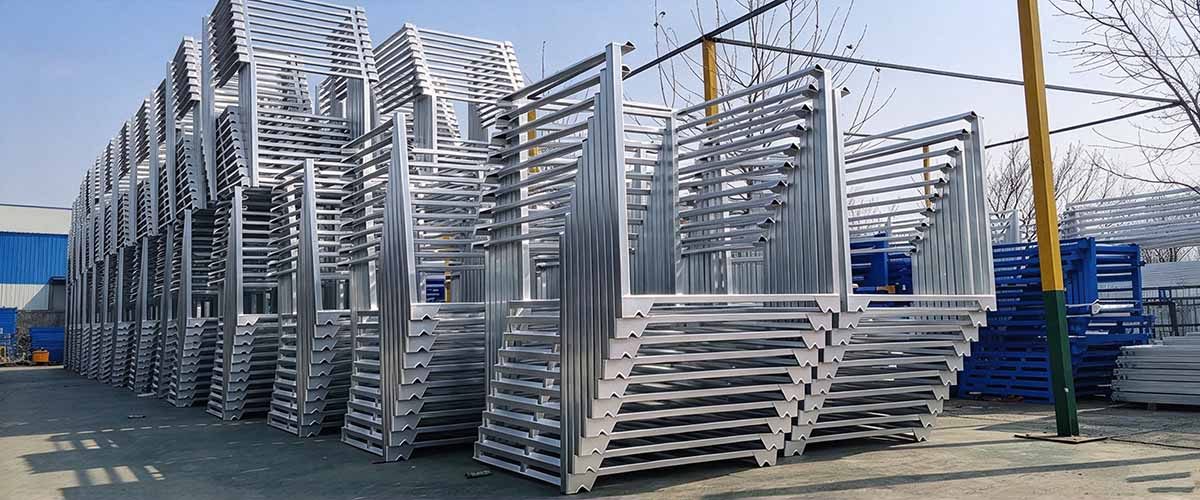
Unlike bolted selective racks, stacking racks feature a 100% welded monolithic frame consisting of a heavy-duty base deck and four vertical corner posts. At the top of each post are precision-tapered locating shoes (receptacles) that allow identical units to be stacked safely on top of one another—typically 3 to 5 tiers high—using a standard forklift.
The Physics of Stability: The “Gravity-Lock” Mechanism
A common concern among warehouse safety managers is whether stacked portable frames remain stable under heavy industrial weights. High-performance stacking racks utilize physics to solve this:
Self-Aligning Footings: The base feet of an upper rack drop securely into the flared receptor cups of the rack below.
The Heavier, The More Stable: As you load dense merchandise (such as automotive transmissions, metal tubing, or heavy industrial tires) into the racks, downward gravitational force intensifies. This immense vertical pressure locks the mating joints tighter together, making the multi-tier stack more stable and resistant to shifting the heavier the cargo gets.
2. Key Operational Scenarios: Solving Real Warehouse Bottlenecks
Stacking racks are not a one-size-fits-all commodity; they solve specific, high-friction operational challenges across distinct warehousing scenarios:
Scenario A: Managing Seasonal Inventory Surges in 3PL Warehouses
The Pain Point: 3PL providers handle volatile client inventories. Renting extra off-site warehouse space during peak retail seasons cuts deep into profit margins.
The Stacking Rack Solution: Because these racks require zero floor anchors and can be stacked safely up to 5 tiers high, logistics operators can instantly expand their vertical storage density during peak months. When the contract ends, the racks are unstacked and cleared out just as fast.
Scenario B: Storing Heavy, Irregular, or Crush-Prone Goods
The Pain Point: Traditional block-stacking (stacking heavy pallets directly on top of each other) crushes bottom-tier goods, resulting in high shrinkage rates and unsellable inventory.
The Stacking Rack Solution: Stacking racks transfer 100% of the upper load’s weight directly through the heavy-gauge steel corner posts straight to the concrete floor. Your merchandise remains completely shielded from compression damage.
Scenario C: Reclaiming Floor Space from Empty Packaging
The Pain Point: Empty wooden crates and fixed racks take up just as much floor space as full ones, creating chaotic staging zones.
The Stacking Rack Solution: High-quality nestable stacking racks feature a clever tapered base geometry. When empty, multiple units slide linearly into one another. A towering stack of 6 to 8 empty racks takes up the footprint of only a single unit, slashing empty storage space by up to 80%.
3. Technical Specifications & Material Standards for Industrial Buyers
When sourcing industrial equipment for heavy-duty environments, structural integrity and compliance dictate safety and longevity. Below are the standard manufacturing benchmarks to look for:
| Technical Parameter | Industrial Grade Specification |
| Structure Type | 100% Fixed, All-Welded Monolithic Frame (Zero Hinges/Bolts) |
| Material Grade | High-Tensile Structural Carbon Steel (Q235B / Q355B / ASTM A36) |
| Single Unit Load Capacity | 1,000 kg to 3,000 kg (2,200 lbs to 6,600 lbs) per individual tier |
| Safe Stacking Height | 3 to 5 tiers high under certified maximum load |
| Nesting Efficiency | Reclaims 75% to 80% floor space when empty |
| Surface Finish | Thermosetting Powder Coat or Corrosion-Resistant Hot-Dip Galvanizing |
4. Safety Compliance & Best Practices (E-E-A-T & Regulatory Standards)
To maintain a secure working environment and protect warehouse personnel, operational protocols must align with established industrial safety frameworks:
OSHA Compliance: Always adhere to guidelines such as OSHA 1910.176(b) regarding secure material storage and stability. Never exceed the manufacturer’s certified Safe Working Load (SWL) limit.
Floor Load Verification: Ensure your warehouse concrete slab is smooth, level, and engineered to bear the concentrated point loads transmitted by stacked post feet.
Routine Maintenance: Conduct periodic inspections for bent corner posts, damaged locating shoes, or weld stress. Immediately tag out and replace any compromised units.
Frequently Asked Questions (FAQ)
Q1: What is the maximum safe stacking height for warehouse stacking racks?
A: Standard industrial stacking racks can typically be stacked 3 to 5 tiers high, depending on the total weight of the unit load and the structural parameters of the corner posts.
Q2: How do stacking racks differ from standard selective pallet racks?
A: While selective pallet racking is bolted permanently into concrete and ideal for high-SKU random picking, stacking racks are entirely portable, require no floor anchors, can be moved fully loaded with a forklift, and nest compactly when empty.
Q3: Can these racks be customized for non-standard product sizes or special forklifts?
A: Yes. Custom dimensions, fork pocket configurations, and specialized base decks (such as open steel mesh or solid plates) can be engineered to match your exact inventory profile and material handling fleet.
Ready to Optimize Your Warehouse Density? Request a Custom Quote Today!
Stop letting inefficient storage layouts, damaged inventory, and wasted floor space eat into your profit margins. Upgrade to rugged, high-stability stacking racks for warehouse operations engineered to perform under pressure.
👉 [Click Here to Request Your Free Custom Quote & Engineering Consultation Now!]
Connect with our material handling experts today. Share your warehouse dimensions, load requirements, and SKU profiles, and receive a professional engineering proposal and competitive wholesale pricing within 24 hours.