
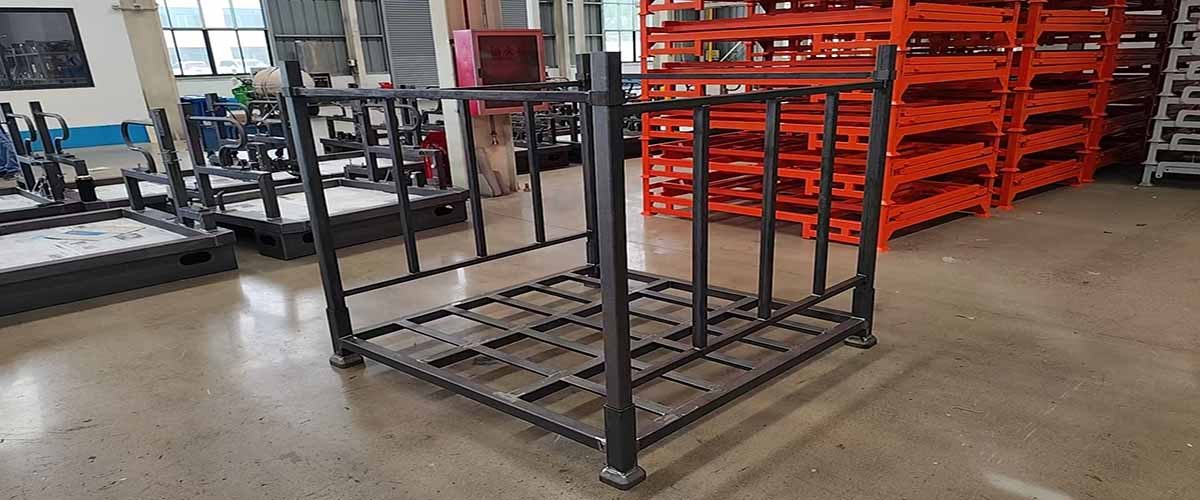
Advantages of Battery Stacking RacksPlacing heavy duty batteries and industrial equipment directly on the ground of the warehouse will make the usage of your space very inefficient, make inventory management very confusing and directly stacking goods may damage the lower items. It is possible to use battery stacking racks properly which will help in storing heavy duty items in a neat manner, make use of the vertical space in the warehouse, and also support forklift operation of materials.About JULI supplies custom steel storage equipment in the form of racking, containers, and other storage solutions for the heavy industries of warehousing and materials handling. JULI stacking racks for batteries are made up of an all-welded steel structure, have square uprights, are built on a steel bottom, and have a powder coat.
Our racking systems can be modified in terms of dimensions and structure according to the type of products, storage arrangements, and operational environment.A Real-Life ExperiencePackaging and storing equipment for industrial production is done at very high speed with the help of proper storage systems. The warehouse should have the capability of quickly and safely handling large volumes and at the same time, the storage system needs to be adaptable to different types of products and different handling methods.
Since the first order of the project in September 2026 came off the factory and was shipped, 120 custom battery stacking racks were made and shipped to Venezuela. This project showcases how we, a manufacturer of steel storage equipment, supply products at custom-made dimensions tailored for different customers of the industry in different countries of the world.Purposes of Using Stacking Racks for Battery StoringIf you work in battery production and need storage for your products in battery storage, warehouses, distribution centers, etc., then this will be a helpful guide of explanation of the product configuration of battery stacking racks, their intended uses, possible modifications, and major issues that will influence placing orders. DefinitionA Battery Stacking Rack is essentially a steel frame that is used to carry the weight of batteries with proper packaging or other industrial goods as loads.Multiple Batteries Stacked Racks on ShelvesWhen several fully loaded racks are brought to their correct vertical stacking by stacking them one above the other, the warehouse is made less cluttered besides that there is much less floor space left.The Benefits of the Stacked Battery Stacked Racking Systems in the IndustryThe use of Battery Storage Racks is different from stacking directly on the ground because, here, by the means of steel structure, the stacked weight is transferred from one pallet to the other and the dependence on the strength of the packaging is eliminated to some degree. This way, one can keep goods in a more ordered manner.Areas Of Industrial UseIndustrial storage battery stacking racks can be in the battery manufacturing, automotive spare parts storage, industrial warehouses, and logistics centers where goods are kept in separate units and moved by forklift.Factors To Consider In The Selection Of A Racking SystemThe ideal design of the rack will be determined by the size of the freight, the loaded total weight, the gravitational center, the height of stacking, the forklift availability, and warehouse conditions. These parameters must be taken into consideration in order to finally determine the capacity and stacking levels.
What is the Advantage of Choosing a Heavy-Duty Battery Stack Rack?
1. Save More Space
You may imagine how much space a large pile of heavy goods stored at ground level occupies when inventory volume increases. This is especially true in production facilities where warehouse areas must also be used for setting up production lines, forklift truck movements, and loading operations. A height adjustable and stackable steel storage rack enables multiple pallets to be stored one upon another. The number of floor spaces used is dramatically reduced which means much less time for picking and much less storage space.
The actual saving can only be determined through measurement of rack size, width of aisle, available total height of building, fork-lift clearance, and possible stacking configuration.
2.Keep the Packaged Goods in a Good Condition
Sometimes stacking two different sets of batteries without an intermediate space can cause compression or deformation, especially at the base ones, due to the lack of strength and resistance of the lower packages. A sturdy battery storage rack provides a separate metallic support structure whose pillars and base frame carry the whole system load through the shelf without relying wholly on the underlying boxes.
Therefore, the location of the base frame must perfectly suit the size of the cargo load and its weight distribution. While a right-designed structural support helps minimize the direct pressure exerted on a stackable battery, proper loading and positioning procedures cannot be overemphasized.
3.Help with the Movement
Heavy items of battery are very unlikely to be handled manually, which is why the compatibility of a battery stacking rack with a forklift becomes crucial. Besides helping with the grouping of batteries into a single handling unit by the rack itself, a stackable battery shelf also assists moving materials from receiving through production, to storage and dispatch.
This can include making the base-frame dimension to be according to the type of customer’s forklift, fork dimensions, forklift truck approaching and departing directions, and required clearance. Forklift compatibility also must take care of the loaded weight and the lift capacity of the lifting machinery which must be compatible with its rated capacity on its relevant load center.
4. Provide Flexibility for Reorganization
In some production settings, it may be necessary to relocate warehouse storage areas based on shifts of schedules, delivery of raw materials and shipment of finished products.
Certainly, a self-standing stacking rack can be moved either when it is empty or under an authorized procedure while loaded. Therefore, warehouses can get a lot of advantages such as changing storage positions of materials and the need to permanently anchor the storage structures.
The real advantage one gets, however, depends on the rack’s weight, method of handling, and operating procedures. A loaded relocation is only possible when a stack rack and the lifting method are particularly built for it.
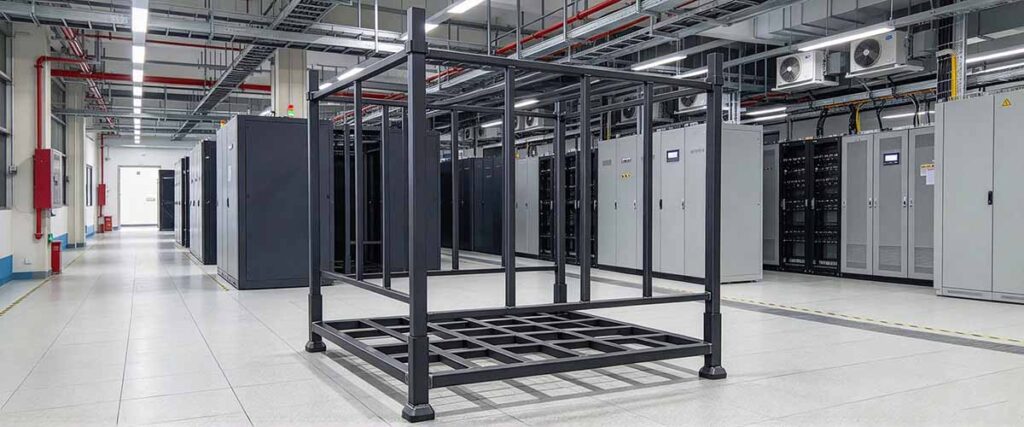
JULI Battery Stacking Rack Specifications
The following specifications are based on JULI’s battery stacking rack project exported to Venezuela in September 2026.
| Specification | Project Details |
| Product name | Battery Stacking Rack |
| Structure | All-welded steel frame |
| Internal dimensions | 1300 × 1300 × 1300 mm |
| Upright section | 50 × 50 × 3.0 mm square steel tube |
| Base frame section | 50 × 50 × 2.0 mm square steel tube |
| Surface treatment | Powder coating |
| Project color | Orange |
| Handling method | Forklift handling |
| Order quantity | 120 units |
| Export destination | Puerto Cabello, Venezuela |
| Rated load capacity | Subject to final approved engineering design |
| Permitted stacking levels | Subject to final approved engineering design |
The stated dimensions refer to the internal dimensions, not necessarily the overall external size. Final external dimensions should be confirmed on the approved technical drawing.
The steel tube dimensions describe the sections used for the uprights and base frame. They do not independently establish the rack’s allowable load capacity.
For a new project, JULI can review the required dimensions, cargo weight, handling method, and storage arrangement before confirming the appropriate structural configuration.
Key Structural Features of the Industrial Battery Stacking Rack
All-Welded Steel Construction
The main structure uses welded steel components to form an integrated frame. This configuration provides a practical basis for repeated industrial storage and handling while reducing dependence on removable assembly connections.
Weld quality, material thickness, joint geometry, and fabrication accuracy all contribute to structural performance. Manufacturing inspection should follow the approved technical drawings and agreed quality requirements.
Square-Tube Uprights
The Venezuela project uses 50 × 50 × 3.0 mm square steel tubes for the uprights.
These members form the principal vertical supports and transfer loads through the frame. Their suitability depends on material grade, member length, connection details, load distribution, and the intended stacking arrangement.
For heavier cargo or greater stacking heights, the upright section and overall structure should be assessed as part of the complete engineering design.
Steel Base Frame
The project uses 50 × 50 × 2.0 mm square steel tubing for the base frame.
The base supports the stored goods and connects the main structural members. Its layout must match the cargo footprint and load distribution while allowing the intended forklift access.
Customers should provide the dimensions, maximum loaded weight, and preferred fork-entry direction so that the base configuration can be evaluated for the application.
Stackable Design
The rack is intended for vertical storage where the approved design permits stacking. The upper and lower interfaces must align correctly, and the structure must remain stable under specified operating conditions.
Permitted stacking levels depend on the complete rack design, loaded weight, stacking interfaces, floor conditions, and handling practices. The ability to place one rack on another does not establish a safe stacking height without engineering verification.
Orange Powder-Coated Finish
The Venezuela project features an orange powder-coated finish. Powder coating provides a finished appearance and surface protection under suitable operating conditions.
Other colors or surface treatments can be considered according to customer requirements. Facilities exposed to high humidity, corrosive chemicals, outdoor weather, or aggressive cleaning processes may require a separate assessment of the protective coating system.
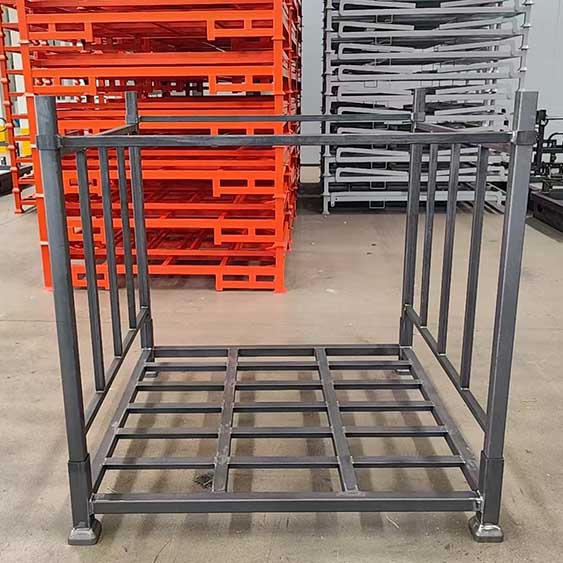
Heavy-Duty Battery Stacking Racks
Boost warehouse efficiency and protect heavy goods with our custom-engineered Battery Stacking Rack. Featuring a robust all-welded steel frame, 50x50mm square tubing, and optimized forklift compatibility, this modular stacking solution maximizes vertical storage while preventing product crushing. Ideal for battery manufacturing, automotive supply chains, and heavy industrial logistics.
Applications of Battery Stacking Racks
Battery Manufacturing and Distribution
Battery manufacturers, wholesalers, and distribution facilities may need to store packaged batteries before production, during internal transfers, or before dispatch.
A battery stacking rack helps organize compatible packages into defined storage units and supports forklift-based movement. The design must account for battery dimensions, total weight, packaging, and any special handling restrictions.
Where batteries require temperature controls, ventilation, segregation, or specific fire protection measures, the storage arrangement must also meet the applicable product requirements and local regulations. A steel stacking rack does not replace these safety provisions.
Automotive Parts Storage
Automotive manufacturing and aftermarket distribution involve components with different shapes, weights, and packaging requirements.
A custom steel stacking rack can be designed for compatible battery packages or selected automotive components. Dimensions and internal supports should be matched to the actual goods rather than assuming one configuration suits every part.
Industrial Manufacturing and Warehousing
Factories often handle heavy components between machining, assembly, inspection, and finished-goods storage.
A purpose-built industrial stacking rack provides a repeatable storage footprint and allows compatible loads to be moved as a unit. It may be suitable for mechanical parts and other industrial goods when the cargo dimensions, weight, and support requirements are compatible with the design.
For components that can shift, roll, or extend beyond the supporting frame, additional restraints or a different storage configuration may be necessary.
How to Choose the Appropriate Battery Stacking Racks
When battery stacking racks are being selected, simple length, width, and height dimensions can easily fool one. But it is really important to check if the rack’s structure is compatible with the goods being stored, the materialhandlingequipment and the storage plan which have been decided.
1. Check Cargo Dimensions
Give length, width, and height of the whole load including packaging and any component which goes out. Let others know whether the measure is of the product or whole packing including packaging.
The internal dimensions of the stacking rack should be enough to allow loading and lifting the goods without getting stuck. This is, however, subject to safety supports and clearances requirements.
We took Venezuela’s internal dimensions as the basis for our work: 1300 × 1300 × 1300 mm. Of course, there are other situations that have different requirements.
2. Compute the Highest Load that the Rack can Bear
You need to figure out the total weight of the stacking rack when a maximum number of goods is placed inside – do not forget that the weight is not just the sum of individual products (e.g. batteries) or packages. Also, if there is the possibility for one rack to receive multiple types of products then think of the weight of the combined products when they are heaviest and at the same think that they can possibly be imbalanced in the whole stack.
When battery stacks are stacked in a battery rack that allows the stack on the top to be heavier than that below by means of compression or if the stacks are not level (i.e one stack is shorter than another), the lower battery stack will be compressed and might lose its shape. Therefore, in addition to the maximum load per batterystack, the weight of the batterystack on each battery in a stacked position should be taken into account, as in the example:
Maximum load per batterystack: 200 kg;
Weight from the battery above each battery in a stacked position: for a battery at the lowest position, there are 10 batteries stacked on top and each of them adds, e.g., 2kg, then 10×2=20 kg;
That means a batterystacker at the lowest position actually has a load of 200 kg+20 kg=220 kg;
The above example also shows the maximum number of batteries that can be stacked: the maximum allowable weight of 220 kg (load on the batterystack) / single battery
It is important to remember and include the weight of the steel frames when planning for forklift capabilities and total floor load-bearing capacity.
Engineering analysis is required to determine the rated load capacity. It is impossible or unfair to judge the load a steel structure can bear merely by its physical features.
3. Find Out the Maximum Stacking Level
The number of levels of containers directly increases the load on the lowest rack layer which makes it very important not only to safety of the lowest rack but also to the whole storage layout’s balance.
Get the plan of stacked height, the space above that is usable in the plant and the requirement of lifting the loaded racks if any.
The last design decision of stacking will have to be checked for safety by means of structural engineering calculations.
4. Making fork lifts compatible with the design
Name the make of forklift which will be the best fit, fork length and width, fork lifting ability when measured at a certain load center, which fork enters first and so on;
The design should also foresee that when several types of forklifts will be used they cannot overcome the respective limitations.
5. Surface finish
For indoor storage equipment, which is a part of the industry, powder coating is a very popular option for getting the finish.
In general, the kind of coating that is going to be used is a function among several factors such as level of humidity, chemicals exposure, cleaning method, and environment condition.
If the application environment is very corrosive or it is an outdoor application, it is very important that the measures which can offer protection to the surface of the components must be defined right down.
6. Drawings and Inspection Requirements
Before a product is manufactured, verifying of technical drawing, steel grade, load capacity, welding requirement, and surface treatment type should come under inspection.
Also, there has to be agreement on load testing, inspection by third-party, or providing additional documentation.
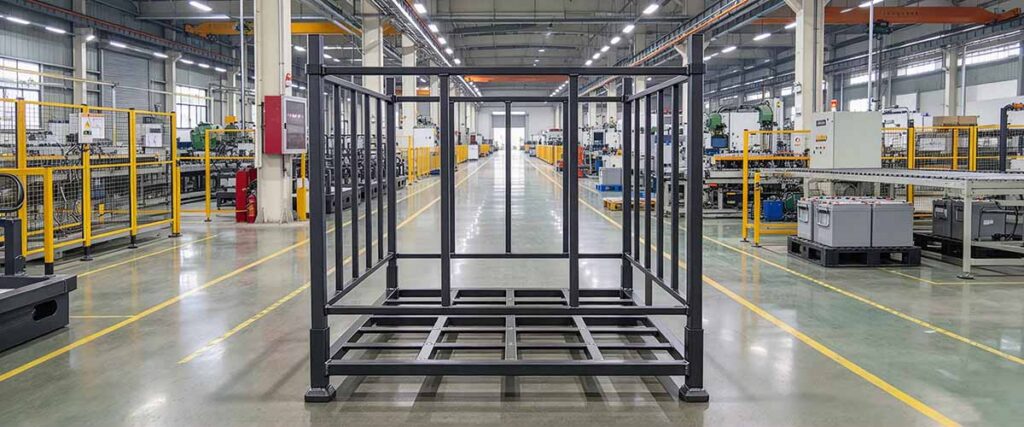
Custom Battery Stacking Rack Manufacturing by JULI
Standard storage equipment does not always fit the dimensions or operating requirements of industrial battery packages. A custom battery stacking rack allows the frame to be developed around the cargo and intended workflow.
JULI manufactures industrial steel storage equipment according to customer requirements and can discuss the following project details:
Custom dimensions: Internal dimensions and overall configuration based on the cargo and available warehouse space.
Structural specifications: Steel sections, base-frame layout, and support arrangements evaluated against the intended load.
Surface treatment: Powder coating and other options assessed according to the operating environment.
Manufacturing inspection: Dimensional, welding, coating, and final checks based on approved drawings and agreed requirements.
Export coordination: Technical confirmation, quantity planning, packaging, container loading, and shipment arrangements for overseas projects.
Customers can provide an existing technical drawing or share product dimensions, cargo weight, photographs, and handling requirements for review.
The specifications of the Venezuela project should not be adopted automatically for other applications. Each new rack configuration needs to be evaluated against its own load and operating conditions.
Venezuela Battery Stacking Rack Export Project: 120 Units
In September 2026, Shandong Juli Storage Equipment Manufacturing Co., Ltd. completed production, container loading, and export shipment of 120 custom battery stacking racks for a project in Venezuela.
The order was prepared for AGRORUEDAS CHAKAO, C.A., with shipment to Puerto Cabello, Venezuela.
Project Overview
| Item | Project Information |
| Customer | AGRORUEDAS CHAKAO, C.A. |
| Destination | Puerto Cabello, Venezuela |
| Product | Custom battery stacking rack |
| Structure | All-welded steel frame |
| Internal dimensions | 1300 × 1300 × 1300 mm |
| Uprights | 50 × 50 × 3.0 mm square steel tube |
| Base frame | 50 × 50 × 2.0 mm square steel tube |
| Finish | Orange powder coating |
| Quantity | 120 units |
| Shipment milestone | Production, container loading, and export shipment completed in September 2026 |
Manufactured to Project Specifications
The racks were manufactured to the specified internal dimensions and structural configuration. The all-welded steel frame, square-tube uprights, and base frame formed the principal structure, while orange powder coating completed the specified finish.
This project provides concrete information for buyers evaluating a custom steel storage rack manufacturer: defined dimensions, specified structural sections, a confirmed order quantity, and an international export destination.
Post-installation performance data and customer operating feedback have not been confirmed. Therefore, no quantified warehouse-efficiency improvement, specific load rating, or safety outcome is claimed.
For comparable projects, the approved technical drawing and engineering calculations should establish the rated load and permitted stacking configuration before the racks enter service.
Battery Stacking Rack vs. Direct Floor Stacking
The right storage method depends on the cargo, available space, packaging strength, and handling requirements.
| Evaluation Factor | Direct Floor Stacking | Engineered Battery Stacking Rack |
| Vertical space | Limited by package stacking restrictions | Can support vertical storage when approved by design |
| Load transfer | Lower packages may carry upper-package loads | Steel frame transfers the supported load |
| Storage organization | Depends on the arrangement of packages | Provides defined storage-unit dimensions |
| Forklift handling | Depends on the cargo and packaging | Can be configured for specified forklift access |
| Layout flexibility | Depends on the storage method | Independent units can be relocated under approved procedures |
| Customization | Limited by package design | Dimensions and structural details can be specified |
A stacking rack is not automatically suitable for every battery storage operation. If goods require individual picking, charging, temperature control, or specialized fire protection, additional equipment or a different storage configuration may be necessary.
The rated load capacity must be confirmed against the final approved engineering design. It cannot be determined from the steel tube dimensions alone. Customers should provide the maximum loaded weight and required stacking arrangement for assessment.
How many racks can be stacked vertically?
The permitted number of stacking levels depends on the structural design, loaded weight, stacking interfaces, floor conditions, and operating environment. It must be confirmed through engineering review.
Is the rack suitable for forklift handling?
The project rack is intended for forklift handling. Compatibility with a specific forklift must be verified against the base configuration, fork dimensions, rated capacity, and handling direction.
What surface treatments are available?
The Venezuela project used orange powder coating. Other colors or finishes can be discussed according to the customer’s requirements and operating environment. Corrosive or outdoor conditions require a separate assessment.
Can the rack be used for products other than batteries?
Potential applications include compatible automotive components, mechanical parts, and other industrial goods. Suitability depends on cargo dimensions, weight, center of gravity, and support requirements. The battery project specifications should not be applied automatically to unrelated products.
What information is needed for a quotation?
To evaluate a custom battery stacking rack project, provide:
Cargo dimensions, including packaging.
Maximum loaded weight per rack.
Required internal dimensions.
Desired stacking levels.
Forklift type and entry direction.
Storage environment and surface treatment requirements.
Order quantity and delivery destination.
Technical drawings or reference photographs, if available.
Request a Quote for Custom Battery Stacking Racks
If your facility handles heavy batteries, packaged industrial components, or other goods that require organized storage and forklift-based movement, JULI can review your requirements for a custom steel stacking rack.
Send us your cargo dimensions, maximum loaded weight, required stacking levels, forklift specifications, order quantity, and destination country. Our team can then discuss the technical configuration, drawing confirmation, surface treatment, and manufacturing quotation.