
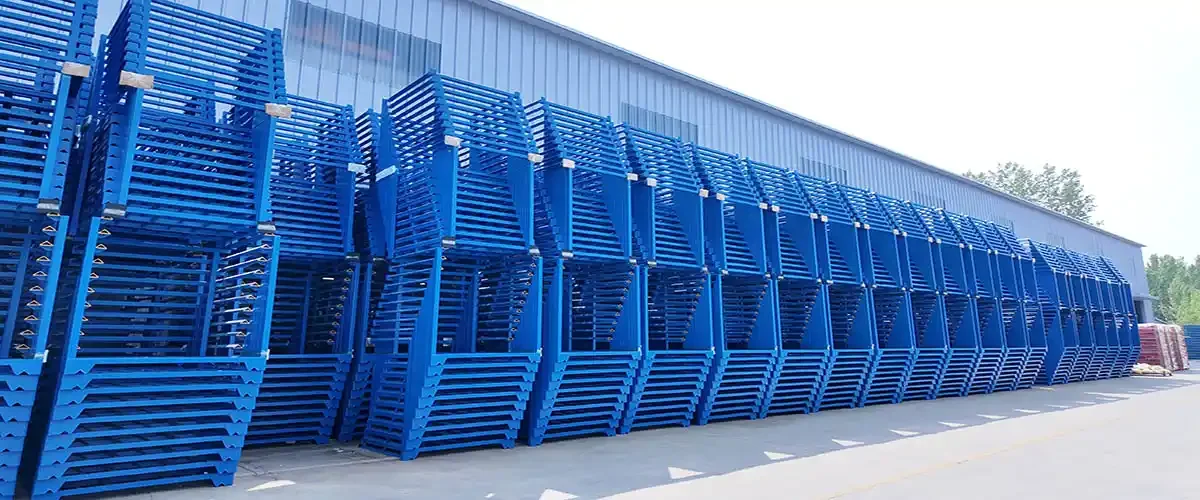
Industrial Stacking Racks provide practical storage in warehouses. They are designed to maximize vertical space, reduce the amount of floor time spent, and keep things on top that you would rather not store on standard shelves or pallet racks.
Stacking is possible in this type of storage, so it makes the warehouse’s storage more packed.
Unlike pallet racking, stacking racks can usually be carried, moved, rebuilt, etc., whenever there are warehouse layout changes. They are therefore suited very well to plants, manufacturers, logistics facilities, warehouses, etc., where storage needs are varied and frequent.
For handling pallets, parts, metals, tires, materials, containers, or odd-shaped goods, stackable industrial racks can indeed be a flexible solution as far as it differs from fixed systems of the warehouse storage.
What Are Industrial Stacking Racks?
The main purpose of Industrial Stacking Racks is allowing the use of vertical space. These are freestanding steel storages which not only support goods but also stack several loaded racks one after the other vertically. They are particularly suitable for warehouses and industrial stores which handle big quantities and bulky materials.
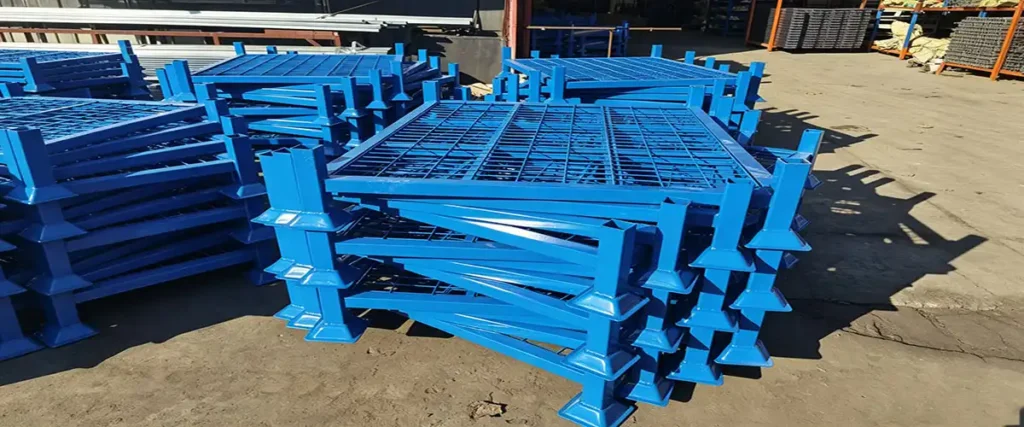
Most common features of a stacking rack are a heavy-duty steel base, vertical steel beams, and the use of optional components. These optional structural elements could include wire mesh, forklift guides, or anti-roll systems, anti-rolls, or support bars. It is through the vertical posts of the stacking rack that the loads are carried downwards from the uppermost racks. So, even if a stack of several racks is standing vertically on a single base, it is the vertical posts, not the base plate, that bear the entire load. This in turn prevents the products stored underneath from bearing the full load pressure.
Such an arrangement of a product’s storage in a vertical stack allows one to save on the floor space and, by extension, to use the warehouse more economically.
How Do Industrial Stacking Racks Work?
The basic principle behind an industrial stacking rack is vertical load transfer.
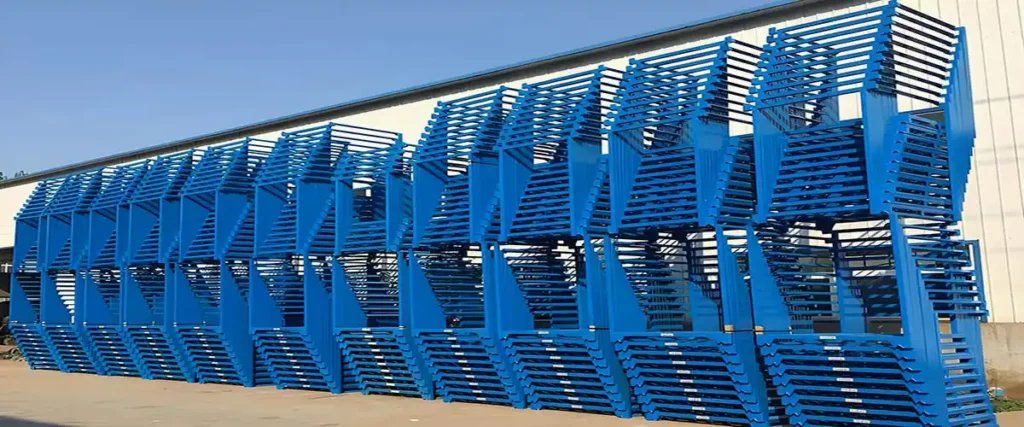
Instead of placing one pallet directly on top of another, each rack provides an independent steel support structure. When multiple racks are stacked, the vertical posts of each unit align with the rack below it.
This creates a stable vertical storage column while keeping the stored products separated.
A typical operating process is:
Goods are placed inside or on the base of the stacking rack.
A forklift moves the loaded rack to the designated storage position.
The rack is positioned above another compatible rack.
The vertical posts or stacking features engage with the lower rack.
Multiple racks can be stacked according to the manufacturer’s rated stacking height.
Individual racks can later be removed with a forklift when the goods are required.
The exact number of racks that can be safely stacked depends on the rack design, load capacity, dimensions, steel specification, floor conditions, and manufacturer’s engineering requirements.
For example, commercial stacking rack products commonly specify stackability such as four units high, but this should never be treated as a universal specification.
Key Benefits of Industrial Stacking Racks
1. Maximize Vertical Warehouse Space
One of the biggest advantages of stackable industrial racks is their ability to utilize vertical warehouse space.
Instead of storing products across a large floor area, multiple loaded racks can be arranged vertically. This can increase storage density while reducing unnecessary floor-space consumption.
For warehouses where floor space is expensive or limited, vertical storage can significantly improve space utilization.
2. Flexible Warehouse Storage
Unlike fixed pallet racking systems, stacking racks can be moved and rearranged according to production or inventory requirements.
This flexibility is especially valuable for:
Seasonal inventory
Manufacturing components
Automotive parts
Tires
Raw materials
Finished products
Returnable packaging
Bulk industrial products
When inventory levels change, the racks can be relocated without modifying a permanent rack structure.
3. Easy Forklift Handling
Many warehouse stacking racks are designed to provide forklift access from one or more directions.
Forklift pockets, guides, reinforced bases, and appropriate rack clearances can make loading and unloading more efficient.
However, forklift access should be considered during the design stage rather than added after manufacturing. Rack dimensions should match the forklift type, fork length, warehouse aisle width, and handling process.
4. Better Product Protection
Directly stacking products on top of one another can create excessive pressure on lower products.
A properly designed stackable steel rack transfers the vertical load through its structural frame instead of relying entirely on the products underneath.
This can help reduce crushing, deformation, and product damage, particularly when storing irregular, fragile, or high-value industrial components.
5. Reusable and Long-Term Storage Equipment
Steel industrial stacking racks can be reused repeatedly in warehouse storage and material-handling operations.
Compared with disposable pallets or temporary storage solutions, reusable steel racks can provide a more durable option for businesses with continuous material flow.
Industrial Stacking Racks vs. Traditional Pallet Racks
Although both systems are used for warehouse storage, their structures and applications are different.
| Feature | Industrial Stacking Racks | Selective Pallet Racks |
| Structure | Freestanding stackable units | Permanent rack frames and beams |
| Installation | Generally simple | Requires system installation |
| Mobility | High | Low |
| Storage flexibility | High | Medium |
| Vertical stacking | Rack-on-rack | Beam-supported |
| Forklift access | Yes, depending on design | Yes |
| Best for | Flexible and bulk storage | High-SKU pallet storage |
| Warehouse layout changes | Easy | More difficult |
| Initial infrastructure | Relatively simple | Requires rack layout and installation |
The choice depends on inventory characteristics and warehouse workflow.
If the operation requires highly flexible storage for relatively homogeneous goods, stackable storage racks can be a strong solution. If the warehouse has thousands of SKUs that require direct access to individual pallets, selective pallet racking may be more appropriate.
Common Types of Industrial Stacking Racks
Not every warehouse requires the same rack structure. Industrial stacking racks can be customized according to the product, loading method, and operating environment.
Stackable Steel Racks
Stackable steel racks are one of the most common configurations. They typically use welded or fabricated steel frames with vertical posts that allow multiple units to be stacked.
They are suitable for general industrial storage, manufacturing components, containers, and bulk materials.
Heavy Duty Stacking Racks
Heavy duty stacking racks are designed for applications requiring higher load capacities and stronger structural components.
The required capacity should be calculated based on:
Maximum load per rack
Number of stacked units
Load distribution
Rack dimensions
Steel grade and thickness
Stacking height
Forklift handling conditions
The rated capacity should always come from the manufacturer’s engineering specifications rather than a generic “heavy duty” label.
Collapsible Stacking Racks
Collapsible stacking racks can be folded or dismantled when they are not being used.
This design is particularly useful for return logistics because empty racks can occupy significantly less space during transportation or temporary storage.
Wire Mesh Stacking Racks
A wire mesh stacking rack combines a steel frame with mesh panels.
The mesh structure provides visibility and ventilation while helping prevent small products from falling out of the rack.
These racks are commonly used for components, packaged goods, automotive parts, and warehouse inventory.
Stacking Racks with Steel Panels
For smaller components or loose materials, steel panels can provide a more enclosed storage area.
Depending on the application, a manufacturer may offer removable steel panels, fixed panels, support bars, or customized partitions.
Applications of Industrial Stacking Racks
The flexibility of industrial stacking racks makes them suitable for many industries.
Manufacturing
Manufacturing plants often need temporary and flexible storage for raw materials, work-in-process components, and finished products.
Stacking racks can be positioned close to production lines and reorganized as manufacturing requirements change.
Automotive Industry
Automotive manufacturers and parts suppliers handle large quantities of components with different shapes and dimensions.
Automotive stacking racks can be customized for engines, metal components, body parts, tires, and other automotive products.
Tire Storage
Tires have unusual dimensions and are difficult to store efficiently using conventional shelving.
Specialized tire stacking racks can provide organized vertical storage while allowing forklifts to handle multiple rack units.
Warehousing and Distribution
For distribution centers handling bulk products or relatively standardized loads, stack racks for warehouse applications can provide flexible storage without the fixed configuration of conventional pallet racking.
Logistics and Transportation
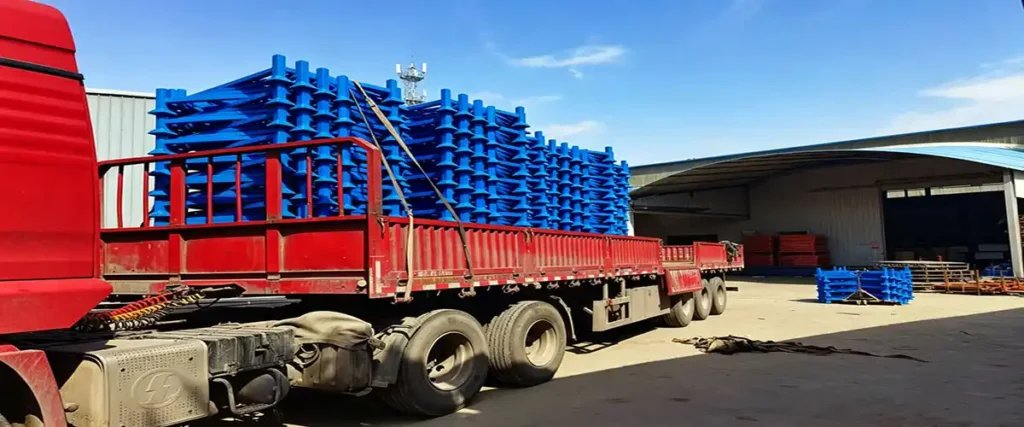
Because many stacking racks can be moved with forklifts, they can also function as reusable material-handling equipment.
Some designs can be transported with products inside the rack, reducing repeated loading and unloading operations.
Recycling and Industrial Materials
Heavy-duty metal stacking racks are also suitable for scrap materials, metal components, pipes, containers, and other industrial products.
Galvanized finishes may be considered where corrosion resistance is important.
How to Choose the Right Industrial Stacking Racks
Selecting the correct industrial stacking rack requires more than choosing a rack based on dimensions or appearance.
1. Determine the Required Load Capacity
Start with the maximum weight that one rack needs to support.
For example, if one rack stores 1,000 kg of material, the rack structure, base, posts, welds, and stacking connection must all be designed for the required operating conditions.
Do not select a rack solely based on its nominal dimensions.
2. Consider Rack Dimensions
The rack dimensions should match the products being stored.
Important dimensions include:
Overall length
Overall width
Overall height
Internal storage dimensions
Post height
Base height
Forklift entry dimensions
Oversized racks can waste warehouse space, while undersized racks may reduce storage efficiency.
3. Determine the Required Stacking Height
The maximum stacking height depends on the rack structure and warehouse environment.
Common commercial designs may support several units stacked vertically, but the allowable height must be confirmed by the manufacturer.
Warehouse ceiling height, sprinkler systems, forklift reach, floor capacity, and operator visibility should also be considered.
4. Select the Right Surface Finish
Common finishes for steel stacking racks include:
Powder coating
Zinc coating
Hot-dip galvanizing
Powder coating is commonly used for indoor environments and allows different colors for product identification.
Galvanized and hot-dip galvanized finishes may be more suitable where additional corrosion protection is required.
5. Consider Forklift Compatibility
Forklift access is a critical factor in the design of warehouse stacking racks.
The rack should be compatible with the forklift’s:
Fork dimensions
Fork spacing
Lifting capacity
Turning radius
Lifting height
Incorrect forklift compatibility can reduce operational efficiency and create unnecessary safety risks.
Custom Industrial Stacking Racks for Different Applications
Standard racks are suitable for many applications, but industrial customers often require customized dimensions and configurations.
A professional industrial stacking racks manufacturer can modify the design according to the customer’s storage requirements.
Customization may include:
Rack length and width
Overall rack height
Load capacity
Post height
Steel thickness
Forklift guides
Wire mesh panels
Steel plate panels
Support bars
Anti-roll bars
Wheels or casters
Identification plates
Surface finish
Color
Collapsible structure
For example, long products may require extended rack dimensions, while small components may benefit from mesh panels or partitions.
Customization should be based on the complete material-handling process rather than simply changing the rack size.
Industrial Stacking Racks Manufacturer: What Should You Look For?
Choosing the right industrial stacking racks manufacturer is important for large warehouse projects and long-term material-handling applications.
Before purchasing, buyers should evaluate:
Manufacturing Capability
A manufacturer should have the ability to control cutting, forming, welding, surface treatment, assembly, and quality inspection.
Load Testing and Quality Control
The manufacturer should be able to provide technical specifications and, where required, load testing or quality documentation.
Important quality-control areas include:
Weld quality
Dimensional accuracy
Steel thickness
Surface coating
Structural stability
Stacking alignment
Load-bearing performance
OEM and Customization Capability
For industrial projects, standard products may not always match the warehouse layout.
An experienced manufacturer should be able to provide custom stackable racks based on drawings, dimensions, load requirements, and handling equipment.
Export and Packaging Experience
For overseas buyers, packaging and container loading are also important.
Stackable or detachable designs can improve container utilization, while proper protective packaging helps reduce damage during international transportation.
Industrial Stacking Racks for Space-Efficient Warehousing
Warehouse space utilization is becoming increasingly important as companies seek to increase inventory capacity without continuously expanding their facilities.
Industrial stacking racks address this challenge by converting unused vertical space into additional storage capacity.
The main advantages can be summarized as:
Higher storage density
Flexible warehouse layouts
Better product organization
Efficient forklift handling
Reusable steel construction
Reduced dependence on disposable pallets
Easy relocation
Customizable dimensions
Suitable for different industrial applications
The key is to match the rack configuration with the actual product and handling requirements.
Industrial Stacking Racks vs. Stackable Storage Racks: Are They the Same?
The terms industrial stacking racks, stackable storage racks, and stackable steel racks are often used interchangeably in the warehouse equipment industry.
In most cases, they refer to storage racks designed to be vertically stacked.
However, the term “industrial” usually indicates that the product is intended for manufacturing, logistics, warehouse, or heavy-use environments.
The actual difference should therefore be evaluated based on the rack’s:
Load capacity
Structural design
Steel specification
Stackability
Dimensions
Forklift access
Surface treatment
Intended application
Buyers should focus on technical specifications rather than relying only on product names.
Common Queries about Industrial Stacking Storage Racks
How high a pile of stacking racks is possible?
The number of stacked industrial stacking racks is usually determined by such factors as rack type and size, weight to be carried, floor status, and manufacturing standards. Commercial ones can go four-levels up in stacking though the limit differs from product to product.
Are they safe for loading heavy weights?
Yes, it is possible as heavy lifting stacking racks will be suitable for most industrial lifting loads. However, the capacity in terms of loads has to be rechecked before use for the same kind of stacker that you have and environment.
Can stacking racks be adjusted to fit our requirements?
Yes, with a great variation in rack height, depth, etc., a manufacturer can offer custom stacking racks besides different load capacities, types of panels and guides, and finishes.
Is stackable metal rack better over traditional pallet racks?
It will depend on your specific needs. While the former is quite portable and can help rearrange the storage easily and often is easier on the wallet as well, the latter will definitely give the best accessibility and space utilizations for warehouses with a very high count of different commodities.
Can stacking racks be installed outside?
Some metal racks of stacking nature can be made to be suitable even for exterior storage. Corrosion proofing can be achieved by galvanized or hot-dip galvanized coatings though a rack made for outdoor use will require it to be so from the beginning.
What types of materials are stacking racks made of?
Stacking racks for industrial purposes are generally made by structural steel or mild carbon steel. The actual quality of metal sheet, the composition grade, as well as thickness will also depend upon the rack design and the required carrying capacity of the racks.
What is the basis of selecting the stacking rack manufacturer?
Choose one that offers steelmaking facilities, has in-house expert engineers, has good manufacturing controls, is very flexible in changing design according to customer’s requirement and supplies for the industries you are interested in through a proven track record.
Wrap-up
In warehouses, the space utilization can be further enhanced by the use of stacking racks as the loaded racking systems can be stacked vertically. Unlike the conventional storage units which are fixed, the racking systems with stacking capabilities give a degree of mobility, make the rearrangements easier and can also serve as efficient storage units when the storage of large industrial or bulk items is required.
Manufacturers, warehouses, logistics companies, automotive shops, etc., who are looking for a storage equipment system that can support a wide range of applications, stacking racks made of steel could be a very good choice for them. The stacking racks could be made in a way that they match the requirements in terms of the load they have to carry, the product size, the type of forklift that is going to be used, the maximum height of the stack, and environmental conditions.
It is important that those who will purchase stacking racks look at more factors than cost, like structural integrity, load-bearing ability, quality of material, coating method, ability to customize, inspection methods and export capabilities.
The perfect stackers for industrial use would not only add additional storage to your premises, but also should blend well into the whole warehouse’s material-handling cycle so as to maximize the warehouse use, avoid product damage, and enhance the level of the operations.