
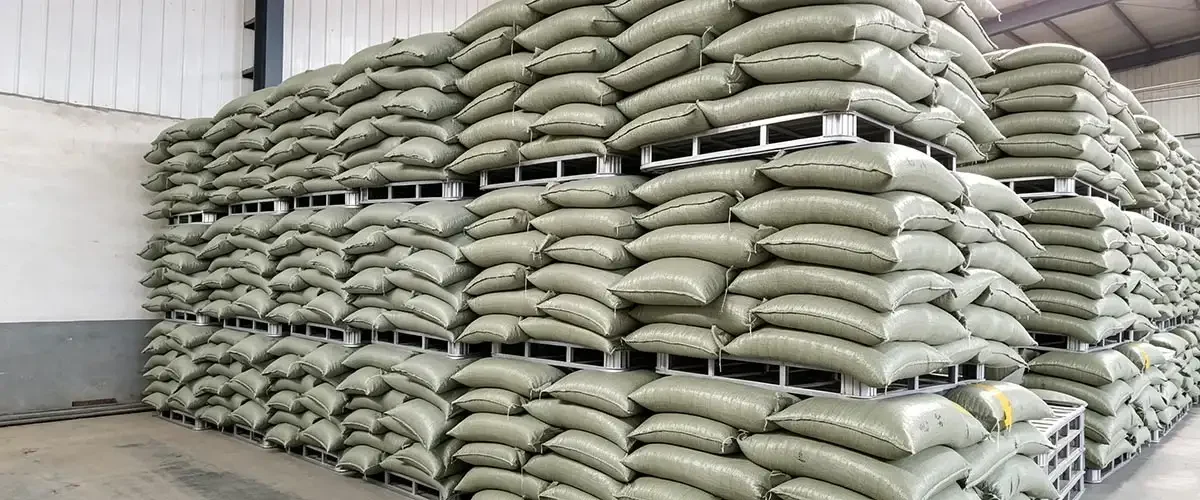
A metal pallet is a reusable load-carrying platform designed for moving, storing, stacking, and handling industrial goods. Unlike a conventional wood pallet, a steel pallet is built for repeated use in applications where durability, consistent dimensions, forklift handling, and long-term warehouse performance matter.
For manufacturers, logistics companies, distributors, and industrial warehouses, metal pallets can be used as a base for palletized goods, a transport platform, or a reusable unit-load carrier. Depending on the design, they can also be used with pallet racking, forklifts, pallet trucks, stacking systems, and other material-handling equipment.
For buyers comparing different pallet materials, the important question is not simply whether steel is stronger. It is whether a steel pallet matches the load, handling method, storage environment, and reuse cycle of the operation.
What Is a Metal Pallet?
A metal pallet is a pallet made primarily from steel or another metal rather than wood or plastic.
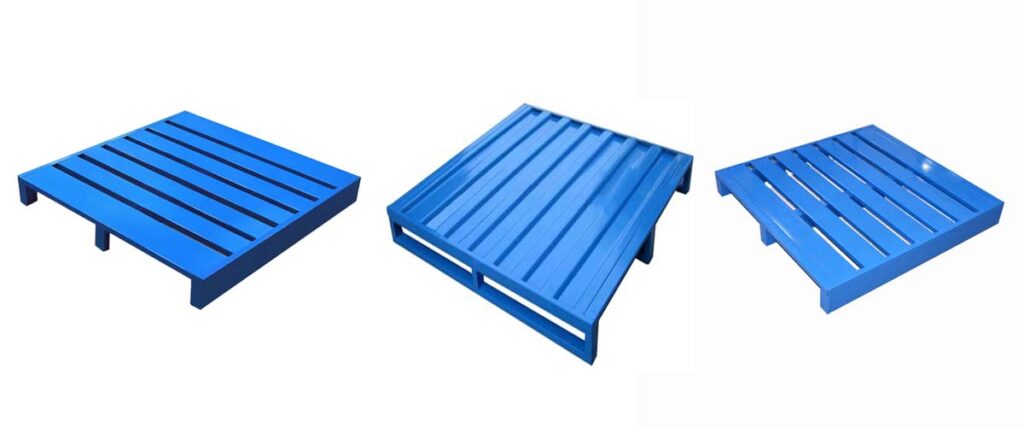
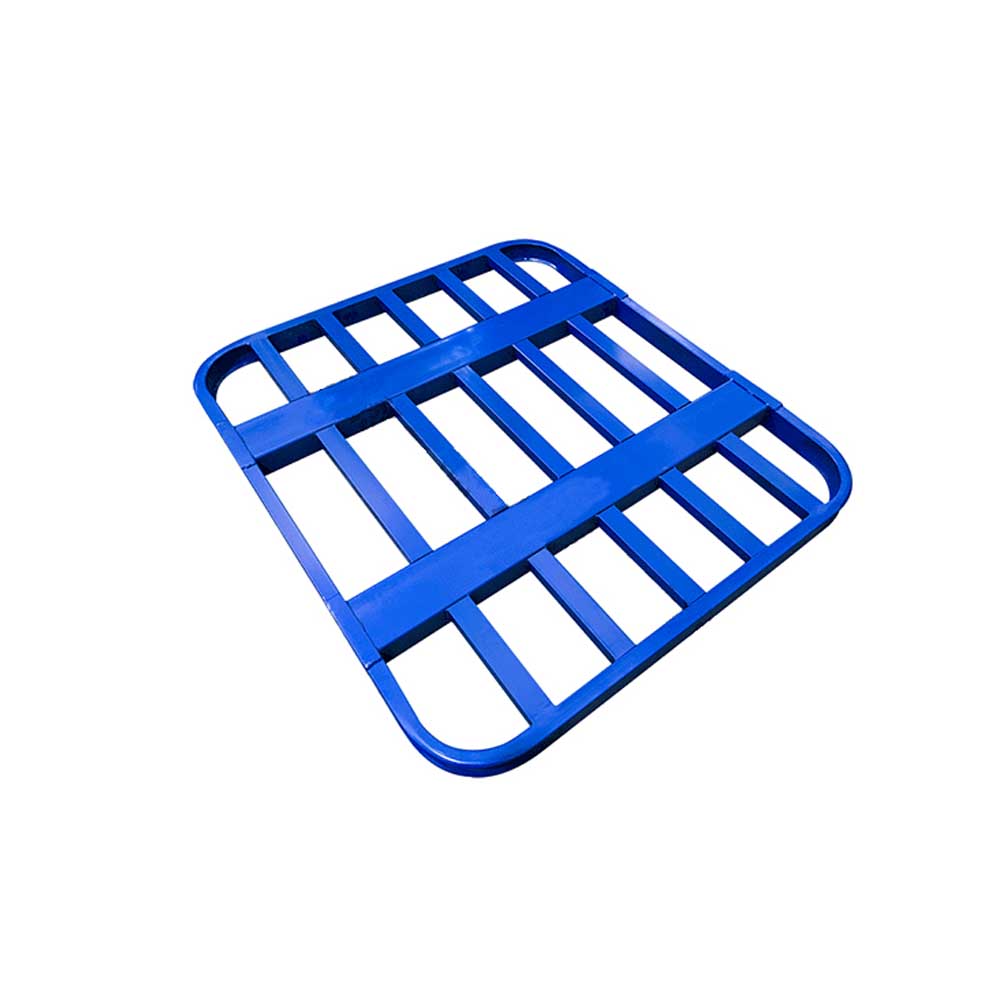
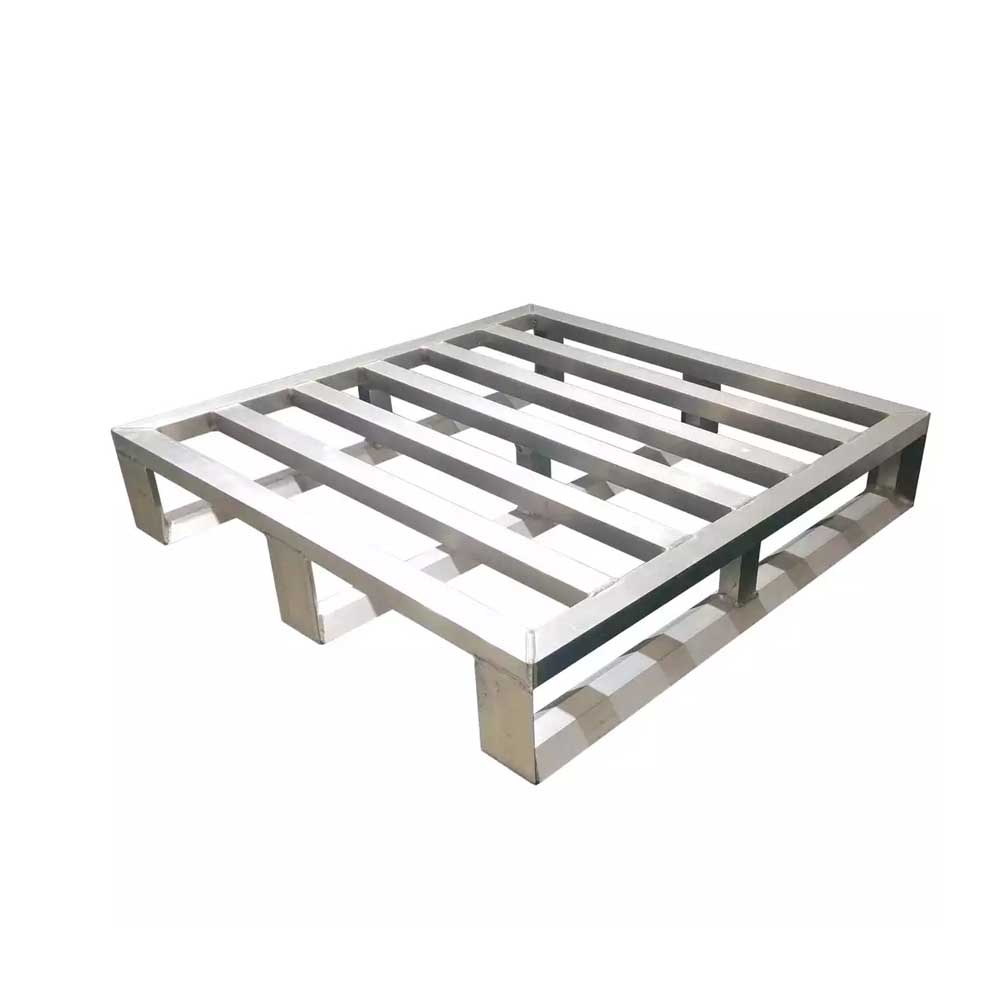
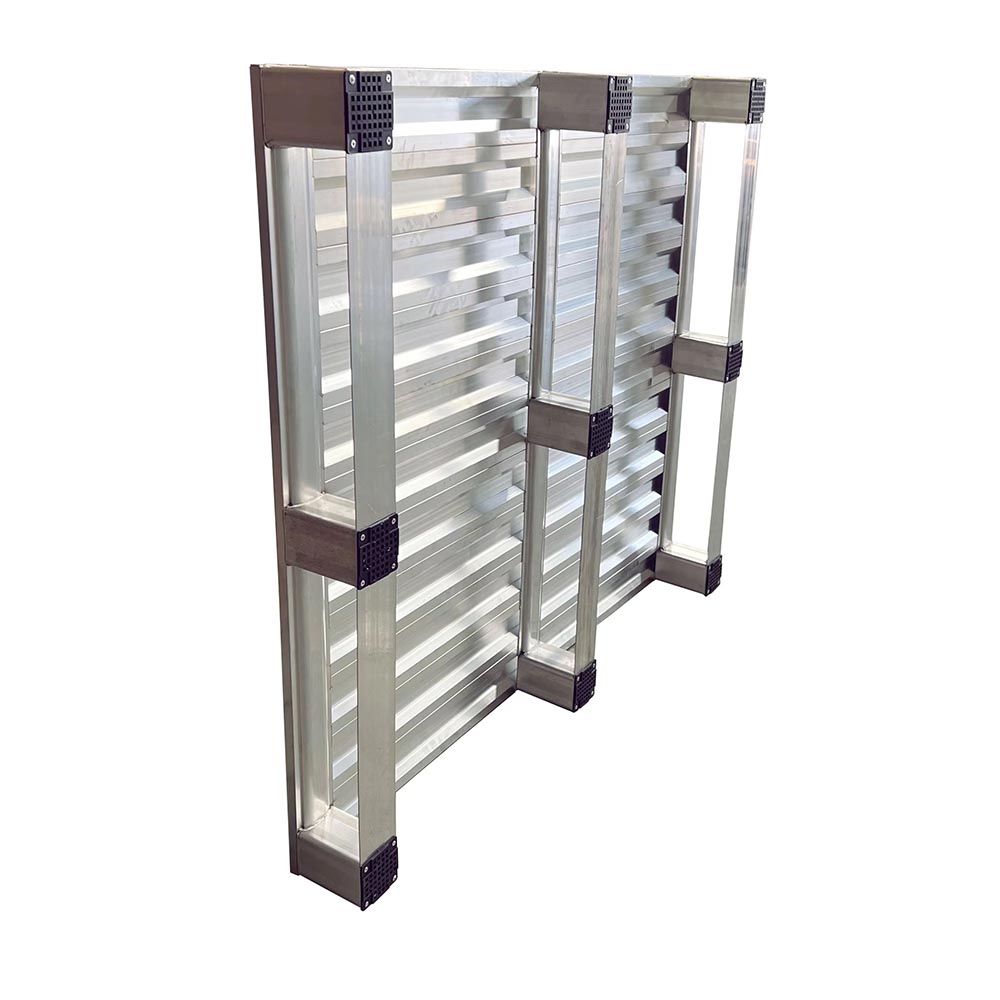
Industrial steel pallets generally consist of a deck, support structure, and forklift entry points. The exact construction varies by application. Some designs use a flat steel deck, while others use reinforced sections, formed profiles, tubes, or open structures to reduce weight while maintaining the required strength.
Common configurations include:
Flat steel pallets
Heavy duty metal pallets
Stackable metal pallets
2-way entry steel pallets
4-way entry steel pallets
Galvanized steel pallets
Powder-coated metal pallets
Current industrial product listings commonly offer both standard dimensions and customized sizes, with 1200 × 1000 mm being one frequently listed format. Manufacturers also offer different load ratings and surface treatments according to the design.
The right specification should always be based on the actual load and handling conditions rather than the pallet name alone.
Why Use a Metal Pallet?
The main reason to choose a steel pallet is repeated industrial use.
A pallet may be loaded, moved by forklift, placed into storage, removed, transported, and reused many times. In these conditions, pallet construction affects more than just the initial purchase price.
Consistent Support for Heavy Loads
Steel provides a rigid structural base for industrial cargo.
This makes metal pallets useful for heavy products, machinery components, metal parts, automotive components, and other loads that require a stable transport platform. Current steel pallet products are commonly marketed for warehouse and logistics storage, with load capacities specified according to the particular structure.
Designed for Repeated Handling
Industrial pallets are often exposed to repeated forklift and pallet-truck operations.
A properly designed steel pallet can be manufactured with forklift entry from two or four sides, depending on the required handling method. Four-way entry designs are frequently offered for warehouse logistics because they give operators more approach options.
Suitable for Reuse
Unlike single-use shipping platforms, steel pallets are intended for repeated handling cycles.
They can remain within a factory’s internal logistics system, circulate between supplier and customer, or operate in a closed-loop transport process.
That makes the pallet a reusable material-handling asset rather than disposable packaging.
Easy to Integrate with Warehouse Equipment
A steel warehouse pallet can be designed to work with existing forklifts, pallet trucks, and storage systems.
Depending on the pallet structure and rated capacity, it may also be suitable for pallet racking or stacking applications. Product listings commonly specify racking compatibility as part of the pallet design.
Metal Pallet vs. Wood Pallet and Plastic Pallet
Choosing between metal, wood, and plastic depends on the operating environment.
| Consideration | Metal Pallet | Wood Pallet | Plastic Pallet |
| Heavy-load use | Strong option | Application dependent | Application dependent |
| Repeated industrial use | Excellent | Good | Good |
| Moisture exposure | Can be protected with suitable finish | Can absorb moisture | Generally resistant |
| Forklift handling | Excellent | Excellent | Excellent |
| Repairability | Often possible depending on damage/design | Common | More limited depending on design |
| Dimensional consistency | High | Can vary with use | High |
| Custom fabrication | High | Medium | More tooling-dependent |
| End-of-life recycling | Steel is recyclable | Reusable/recyclable | Recyclable depending on material |
Metal pallets are not automatically the best option for every operation. Wood remains widely used where low initial cost and general-purpose shipping are priorities, while plastic can be attractive where low weight, cleanability, or specific food and pharmaceutical requirements are important. Recent pallet-selection guides similarly position metal toward heavier-duty and longer-life industrial applications.
The better comparison is therefore cost over the expected number of handling cycles, not purchase price alone.
Heavy Duty Metal Pallets for Industrial Loads
A heavy duty metal pallet is designed when the cargo, handling frequency, or storage configuration requires a stronger structure.
However, “heavy duty” should not be treated as a universal load rating.
A steel pallet can have different capacities for:
Dynamic load during forklift movement
Static load during floor storage
Racking load
Stacked pallet load
These values depend on the deck structure, supports, steel specification, dimensions, and load distribution. Current supplier listings show substantial differences between dynamic, static, and racking capacities across models.
For this reason, buyers should provide the actual load weight and storage method before selecting a pallet.
Stackable Metal Pallets for Warehouse Storage
A stackable metal pallet is designed so that empty or loaded pallets can be stored vertically without relying on the cargo itself to form the supporting structure.
This can be useful when:
Floor space is limited
Empty pallets need organized storage
Palletized products are temporarily stored
Warehouse inventory changes frequently
Forklift handling is used
Stackability depends on the pallet’s feet, base geometry, load distribution, and intended configuration.
Some commercial steel pallets are specifically designed for stacking and warehouse storage, while others are optimized for racking or transport.
2-Way vs. 4-Way Entry Steel Pallets
Forklift access is an important part of pallet design.
2-Way Entry
A 2-way entry steel pallet is accessed from two opposite sides.
This configuration can be suitable when the warehouse layout and handling process are relatively fixed.
4-Way Entry
A 4-way entry steel pallet allows forklift access from all four sides.
This gives operators greater flexibility when pallets need to be approached from different directions, and it is a common option in warehouse and logistics applications.
The correct option depends on the forklift, pallet truck, aisle arrangement, and loading process.
Surface Treatment for Metal Pallets
Steel pallets can be exposed to moisture, abrasion, forklift contact, cleaning processes, and different warehouse environments.
Common surface treatments include:
Powder Coating
Powder-coated steel pallets are commonly used for indoor warehouse and industrial applications. The coating provides a finished surface and helps protect the steel during normal handling.
Galvanizing
A galvanized metal pallet may be preferred where greater corrosion resistance is required.
Electro-galvanized and hot-dip galvanized finishes are both offered in the market, with the appropriate process depending on the environment and required protection.
The finish should be selected according to the actual operating conditions rather than simply choosing the most expensive treatment.
Metal Pallets for Warehouse and Logistics Operations
The most common application for a steel pallet is the movement and storage of palletized goods.
A warehouse may use the pallet through several stages:
Receiving → Storage → Picking or Production → Staging → Shipping
The pallet provides a stable unit-load base while forklifts or pallet trucks move the cargo through the facility.
For operations with repeatable material flows, reusable metal pallets can remain in circulation rather than being discarded after a single shipment.
They can also be integrated with warehouse storage systems where the pallet design and load rating are suitable.
Metal Pallets for Manufacturing
Manufacturing facilities often use metal pallets as reusable load carriers for raw materials, work-in-process components, and finished products.
Their value is particularly clear when the same type of load moves repeatedly between production areas.
For example:
Production line → Temporary storage → Assembly → Finished goods warehouse
A consistent steel pallet footprint makes it easier to standardize handling across these stages.
For machinery, metal parts, castings, automotive components, and other industrial products, the pallet can also be customized around the dimensions and weight of the load.
Metal Pallets for Automotive Parts
Automotive manufacturing and component supply chains often involve repeated internal handling.
Steel pallets can be used for:
Engine components
Transmission parts
Metal assemblies
Automotive parts containers
Work-in-process components
Finished assemblies
The important consideration is not just load capacity. The pallet may need specific supports, locating features, or dimensions to keep the components stable during handling.
The steel pallet market also includes application-specific versions for automotive parts and other industrial products.
Metal Pallets for Agriculture and Food Products
Agricultural and food-related operations may use metal pallets for bags, cartons, crates, containers, and other unit loads.
For example, a warehouse may use them for:
Grain and agricultural products
Flour and rice
Food cartons
Beverage cases
Reusable containers
Agricultural equipment or components
For humid environments, a suitable surface treatment becomes more important. For food and beverage facilities, the pallet design should also be evaluated according to hygiene, cleaning, and contact requirements rather than assuming every painted steel pallet is suitable for direct food contact.
Metal logistics products are currently offered across agriculture, food and beverage, automotive, and other industrial sectors.
How to Choose the Right Metal Pallet
A good pallet specification starts with the load.
1. Load Weight
Define the maximum weight carried on one pallet.
Do not use “heavy duty” as the specification. Provide the actual load.
2. Dynamic, Static, or Racking Use
Determine whether the pallet will be:
Moved by forklift
Stored on the floor
Stacked with other pallets
Placed in pallet racking
These are different loading conditions and may require different structural designs.
3. Pallet Dimensions
Common sizes include 1200 × 1000 mm and other regional pallet footprints, but manufacturers also provide custom sizes.
The correct size should match the cargo, storage equipment, container dimensions, and handling process.
4. Forklift Entry
Decide whether 2-way or 4-way entry is required.
For facilities where forklifts approach pallets from different directions, a 4-way design can make daily handling easier.
5. Surface Treatment
Choose powder coating, electro-galvanizing, hot-dip galvanizing, or another treatment according to moisture, corrosion exposure, cleaning, and operating conditions.
6. Stacking Requirement
If loaded or empty pallets will be stacked, the design needs compatible feet or support geometry.
The manufacturer should specify the allowable stacking condition rather than leaving this to operator judgment.
Custom Metal Pallets for Different Loads
Not every customer needs a standard pallet.
A custom metal pallet can be manufactured around:
Product dimensions
Maximum load
Forklift type
Pallet-rack requirements
Stacking method
Container loading
Surface treatment
Special supports
Identification requirements
For example, a pallet for long metal parts may require a different deck structure from one used for cartons. A pallet for automotive components may need locating supports, while one for general warehouse goods may use a flat steel deck.
Current Chinese suppliers commonly offer OEM/ODM customization for dimensions, structure, finish, and load requirements.
Flat Steel Pallets vs. Pallet Boxes
A flat metal pallet is mainly a load platform.
A pallet box or metal cage pallet adds walls or containment around the goods.
A flat pallet is generally more suitable when:
Goods are already packaged
Cargo is secured with stretch wrap or straps
Forklift handling is the priority
The load needs to enter pallet racking
A pallet box may be more appropriate when loose parts or smaller items need containment.
Choosing between them depends on the cargo rather than assuming one format is better.
Metal Pallets and Container Shipping
Export-oriented warehouses often have another concern: how many pallets fit into a container.
Pallet dimensions, pallet weight, stackability, and packaging method all affect container utilization.
Some supplier listings publish container loading quantities alongside pallet dimensions and weight, demonstrating that transport efficiency is part of the product specification rather than an afterthought.
For custom export orders, it is therefore worth reviewing:
Pallet footprint
Pallet height
Empty-pallet nesting or stacking
Cargo dimensions
Container internal dimensions
Forklift handling during loading
A pallet that is slightly smaller or lighter may sometimes improve logistics efficiency, provided it still meets the cargo and handling requirements.
When Is a Metal Pallet a Better Choice?
A steel pallet is worth considering when the operation has one or more of these requirements:
Repeated reuse
The pallet will circulate through a warehouse or supply chain many times.
Heavy or demanding loads
Cargo requires a rigid, durable platform.
Consistent dimensions
The operation benefits from standardized handling units.
Forklift-intensive handling
Pallets are moved frequently through production or logistics areas.
Special storage requirements
The pallet must work with stacking or pallet racking.
Custom dimensions
The load does not fit efficiently on standard wooden or plastic pallets.
The decision should still be based on total operating requirements rather than simply choosing steel because it is stronger.
What to Ask a Metal Pallet Manufacturer
Before requesting a quotation, prepare the information that determines the pallet design:
| Information | Why the Manufacturer Needs It |
| Product type | Determines deck and support design |
| Product weight | Determines required capacity |
| Product size | Determines pallet dimensions |
| Dynamic/static/racking use | Determines structural requirements |
| Forklift type | Determines entry design |
| Stacking requirement | Determines feet and support geometry |
| Indoor/outdoor use | Determines surface treatment |
| Quantity | Determines production and tooling |
| Destination country | Determines packaging and shipping considerations |
This produces a much more useful quotation than asking only:
“How much is a metal pallet?”
Conclusion
A metal pallet is more than a heavier alternative to a wood pallet.
When correctly designed, it becomes a reusable load carrier for warehouse storage, production handling, transportation, and repeated logistics cycles.
Steel pallets, heavy duty metal pallets, stackable pallets, galvanized pallets, and custom metal pallets can serve different requirements depending on the load, forklift access, storage method, environment, and expected reuse.
For buyers, the most important specifications are not simply material and price. They are load condition, dimensions, entry type, stacking or racking requirements, surface treatment, and the way the pallet will move through the operation.
For manufacturers handling demanding loads or requiring a consistent reusable pallet system, a properly engineered steel pallet can provide a durable foundation for storage and material handling while allowing the pallet design to be adapted to the actual product and workflow.