
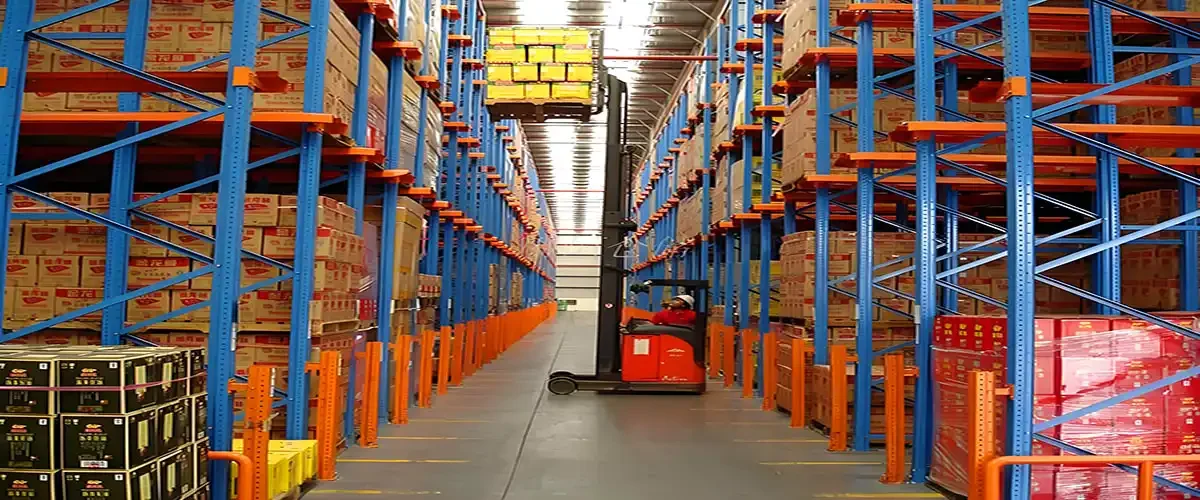
Today,warehouse space has become a critical and costly asset for a business as a result of the fast changing supply chain and logistics industry. There has been an upward trend in inventory volumes and land costs, which has left facility managers no choice but to increase their effort in making the most of each sq ft of available floor space. A regular static shelving with a regular selective pallet racking may be a great solution, but they can hardly cope with the new and modern storage demands as the spaces remain underutilized. This guide will delve into high density racking, which is a warehouse storage technology that can allow your business not only to get more out of your warehouse but can also save you money through the better use of space.High density racking is one way to get the most from the storage of the physical volume of the items which means saving lots of space. So whether you are looking at a major renovation for your current distribution center, or the development of a new fulfillment space, you should always be informed how to incorporate the latest high-efficiency storage technologies into your plans. That’s how you stay ahead of the competition.
What is High Density Racking?
High Density Shelving is a system of industrial storage specially designed to reduce the number of aisles thus freeing up floor space for a larger number of shelves.
For example, it is quite common that a selective pallet rack will require a single aisle for a row of pallets, thereby leaving as much as 40%-60% of the total floor area for just the operation of forklifts.
High Density Racks are the type of racking that has the feature of reducing or even removing these aisles completely.
Such systems make use of a few or none aisles and store multiple items in the depths and heights of pallet spaces.
For that reason, one could say that such systems enable storing far more items within the same warehouse area as compared to typical selective pallet racks.
Understanding the Core Ideas of High-Density Storage
Utilization of Storage Space – It is an approach which considers maximum storage capacity by fully exploiting the vertical clearance and floor density instead of simply spreading out horizontally.
Minimizing Aisle Space – Reduction of the width of aisles would give back floor area to use for storing more inventory or create staging zones.
Storage Capacity Optimization – Using unique loading equipment such as drive-in channels, shuttle carts, gravity rollers and push-back carriages in an efficient way to access the deeper shelves or compartments (deep bay)
Major Differences And Terminology You May Hear
When you create or renovate warehouse premises you will come across various expressions and layout ideas. Understanding and using the right words can also be great for you not only to keep up the SEO efforts but also get a technical insight on the matter to align with international standards. Some very frequently used words are:
High density pallet racking is the solution of choice for the palletized load which requires storage space but not much movement.
High density racks is a general category of warehouse storage system which is able to carry heavy loads in limited space.
High density storage solutions refers to the whole picture of warehouse solutions that involve not only structural elements and hardware but also design plan software.
High density pallet racking system refers to an engineered whole system of pallet racks which is not only resistant but is also designed to bear large weight.
High density storage rack systems refers to very durable industrial infrastructure intended for long term use.
High density warehouse racking is generally for large-scale warehouses and cold storage facilities to name a few.
Detailed Classification of High Density Racking Systems
Different inventory profiles, product turnover rates, and warehouse footprints demand tailored high density racking solutions. Below is a detailed breakdown of the primary systems available in the modern logistics market.
| HIGH DENSITY RACKING SYSTEMS | ||
| Drive-In / Drive-Through | Push-Back Racking | Pallet Shuttle Systems |
| – Last-In, First-Out | LIFO Operation | Semi-Automated Carts |
| High-Volume Storage Depth | Multi-Depth Carts | High Throughput & Depth |
1. Drive-In and Drive-Through Racking
Drive-in and drive-through configurations are classic choices for high-density storage, particularly for bulk storage of homogeneous products.
Drive-In Racking: Operates on a Last-In, First-Out (LIFO) inventory retrieval method. Forklifts drive directly into the rack bay to load or retrieve pallets from a single entry point.
Drive-Through Racking: Features entry and exit points on opposite ends, allowing for First-In, First-Out (FIFO) processing when necessary, though it requires specialized traffic management.
2. Push-Back Racking
Push-back systems use a series of nested carts riding on inclined rails. When a new pallet is loaded, the forklift pushes the existing pallets back. When a pallet is retrieved, gravity gently brings the remaining pallets forward to the pick face.
Inventory Method: LIFO.
Depth: Typically engineered for 2 to 6 pallets deep.
Advantage: Excellent for storing multiple SKUs across different lanes while maintaining high density.
3. Pallet Flow Racking (Gravity Flow)
Pallet flow utilizes inclined roller tracks where pallets loaded at the high end move smoothly via gravity to the picking face at the lower end.
Inventory Method: Strict FIFO (First-In, First-Out), making it exceptional for perishable goods, food and beverage, and date-sensitive products.
Efficiency: Eliminates dead aisle space while ensuring rapid stock rotation.
4. Pallet Shuttle (Radio Shuttle) Systems
The pinnacle of modern high density storage rack systems, the pallet shuttle combines heavy-duty structural racking with a remote-controlled or autonomous robotic cart that travels inside storage channels to place and retrieve pallets.
Versatility: Can support both FIFO and LIFO operational logic depending on warehouse configuration.
Safety & Speed: Eliminates the need for forklifts to drive inside the racking structure, minimizing structural damage and accelerating cycle times.
Comprehensive Technical Specifications
To properly engineer a high density warehouse racking installation, structural integrity, load capacities, and dimensional tolerances must be meticulously calculated. Below is a standard technical specification matrix representing heavy-duty industrial configurations.
| Technical Parameter | Standard Specification Range | Heavy-Duty / Cold Storage Variant |
| Upright Frame Height | 3,000 mm – 12,000 mm | Up to 15,000 mm+ |
| Bay Width (Clearance) | 1,200 mm – 3,500 mm | Customized per pallet dimension |
| Maximum Pallet Weight | 1,000 kg – 1,500 kg per pallet | Up to 2,000 kg per pallet |
| Frame Material | High-tensile structural steel (Q235B / Q355B) | Galvanized or powder-coated anti-corrosion steel |
| Beam Deflection Limit | Max $L/180$ under full load | Strict engineering tolerances |
| System Depth | 2 to 10+ pallets deep | Up to 30+ pallets deep (Shuttle systems) |
| Operating Temperature | Standard ambient ($0^\circ\text{C}$ to $+40^\circ\text{C}$) | Freezing environments down to $-30^\circ\text{C}$ |
Outstanding Product Advantages
Implementing a state-of-the-art high density storage solutions package delivers transformative commercial and operational benefits for growing enterprises.
1. Dramatic Space Optimization
By reducing redundant aisles, businesses frequently reclaim 40% to 80% more storage capacity within the exact same building footprint. This eliminates the immediate need for expensive warehouse expansions or leasing external off-site storage facilities.
2. Enhanced Inventory Control and Flexibility
Modern high density pallet racking systems accommodate diverse SKU profiles, especially when paired with automated shuttle technology or dynamic flow channels. This flexibility ensures that businesses can adapt quickly to seasonal demand fluctuations.
3. Reduced Operating and Real Estate Expenses
When you need to carry more products and at the same time occupy less area you are not only reducing energy requirements and cost on facility maintenance, but you also decrease per-pallet storage costs.
It’s not until many years that you will see your investment in setting up the high-density rack system being completely recouped.
4. Strengthening of the Building Durability Against Accidents
The use of strong cold-rolled steel and the design of the racks to endure even heavy earthquakes and heavy loads is the reason that the new ones are also very sturdy, the upright protectors, the footplates and the locking components help prevent any accident of the operator during lifting operations and of the cargo being knocked down to the floor.
Ideal Applications and Target Sectors
Varying turnover cycles and environmental needs mean high-density racking systems are often tailor-made to suit a broad range of industries:
Cold Storage and Freezers:Maintaining temperature-controlled storage area is quite expensive so by using high-density racking you get the most out of cold air as you have the highest pallet count in the smallest possible area.
Food and Beverage:The systems are most suitable for the flow of bulk quantities of the products, commodities and perishable date-sensitive items by means of reliable FIFO or LIFO flows.
Manufacturing and Automotive:Storing large automotive parts, raw materials, tyres, and sub-assemblies in locked bays is the best solution available.
3 PL Operators:Allows logistics operators to get the most revenue per㎡ by combining client inventories using extremely-efficient storage formats.
Retail and E-Commerce Distribution:It’s an asset for managing seasonal and buffer stock before the items go onto high-velocity pick faces.
Frequently Asked Questions (FAQ)
Q1: Why do companies choose selective over high-density racking?
The answer is Selectives offer a 100% pallet accessibility level but this comes at a price of very wide aisles so that there is overall lower storage density. It should be remembered that selective system design leaves enough space for the operator to reach every single pallet in the aisles easily.
High density racking allows storage of pallets multiple deep by reducing aisles or no aisles at all as compared to the selective where it is an extra space that gives you less storage density but allows easy access.
It is the kind of trade-off you make between the storage capacity and accessibility.
Q2: Is it possible to integrate high density racking into previously built warehouses?
“With”,A:Yes. Skilled warehouse planners can evaluate your existing site plan, ceiling height and flooring weight limit so they may install high density bays or suggest a combination layout that includes both selective and high-density racks as needed.
Q3: How do I decide between LIFO and FIFO high density systems?
A: LIFO vs. FIFO systems can be explained from the standpoint of inventory movement. LIFO is usually the better option for such items which can be stored for a long time, are non-expired or are products that have been left in the warehouse for quite some time. On the other hand,FIFO is usually mandated where the products are consumables, medicine or anything that has a expiry date as a strict requirement.
Q4: Pallet shuttle Automated?
“It is very straightforward to with”<b>A:”No””The modern ones with automated pallet shuttle systems are built for long lasting life with replaceable parts, on-board diagnostic sensors and quick-swap lithium batteries.
You’ll spend most of your time on preventive maintenance.
Summary
The introduction of high density racking is more than the improvement of operational processes, it has become a critical aspect of contemporary supply chain management.
With the help of such strategies not only do companies save money through reduction of the number of aisles and protection of inventory, but they also increase the utilization volume per warehouse significantly thus future-proofing the warehouse operation to a large extent.
Assess the nature of your stock flow, seek expert advice from racking consultants, and convert your warehouse to an ultra-productive warehouse now.